Six facility types, six different ways a loop fails
The consumable set is the same. The priority order is not.
These pages are indexed by how a loop behaves rather than by an industry label. A fab and a colocation hall buy from one catalogue and put a different item at the top of the schedule.
Coolant filtration · leak detection · hose · telemetry, in the order each site needs them
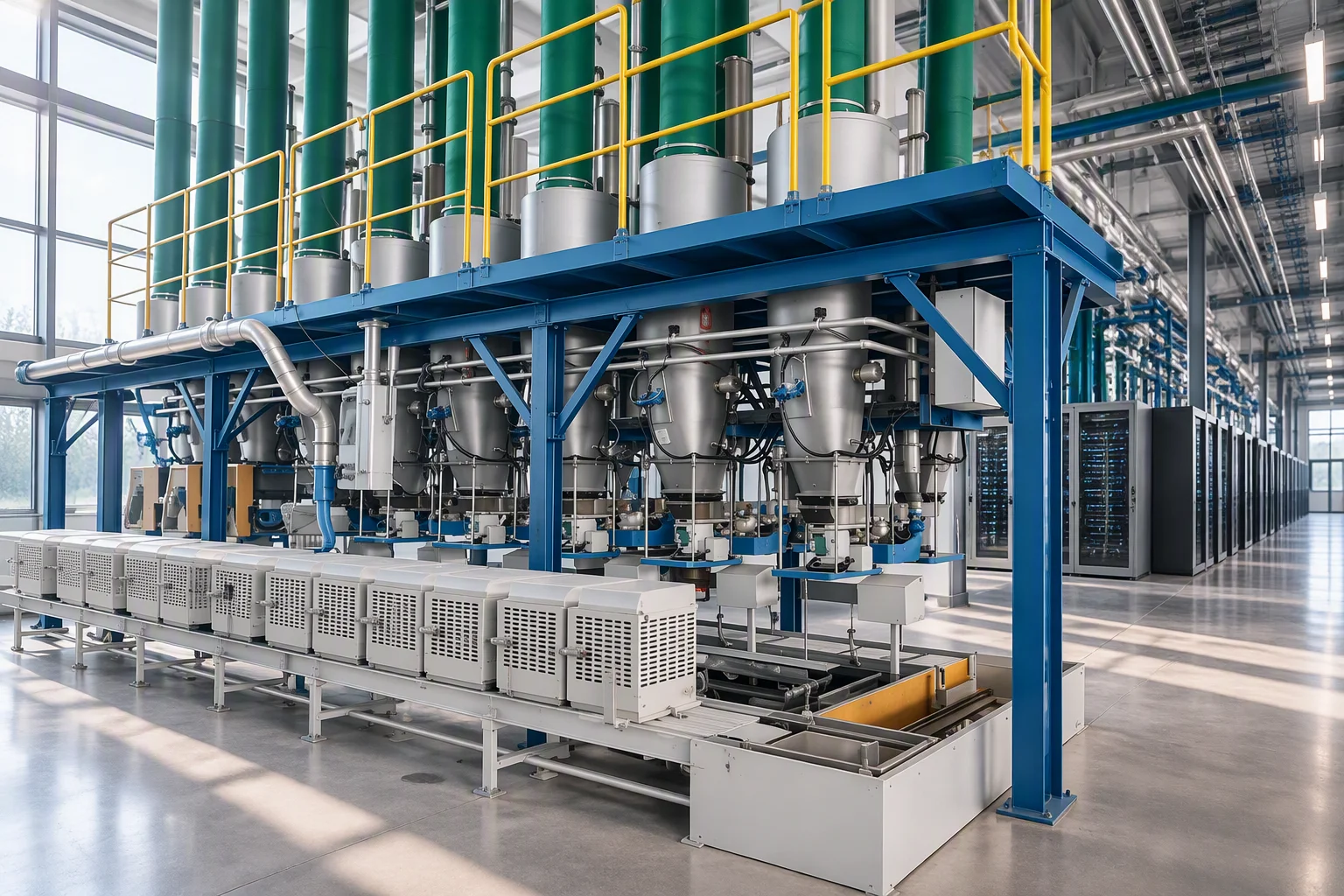
Hall, loop pipework · the joint sits between these rows
Route by the question your own site raises
One row per facility type, carrying the single figure that separates it from the other five.
Colocation
Multi-tenant loop. You do not control what a tenant pours in. Sample every 50–100 days or quarterly.
Hyperscale and AI training
132 kW racks today, 240 kW next generation, in a band where air cooling has already stopped.
HPC and research
Installations that outlive three hardware generations on one set of fittings.
Edge and telecom
Unmanned sites. Nobody sees the first drip, and hose is rated −40 to +99 °C.
Semiconductor fabrication
Particle limits measured in single microns, and a 5 µm protection rating at the cold plate.
EV battery and power electronics
Glycol-heavy chemistry at automotive volumes, up to 55 % v/v on the concentration ladder.
A loop fails at a joint, not at the heat exchanger
Heat rejection is sized once from a curve. The joint works every day afterwards, and it degrades by eight named mechanisms.
Every mechanism below is observed by an instrument or prevented by a consumable. That is why one catalogue serves six facility types.
Eight mechanisms · eight instruments or consumables
Clamp load over months.
Wall thickness and chemistry.
Glycol concentration.
Routing and cover compound.
Start and stop count.
Conductivity and chloride.
Filtration state.
Pump and valve control.
The cost of that failure follows rack density
Loses capacity to an unexpected leak. Vendor-published.
Leak-caused. Same vendor.
Same vendor. Independent benchmarks run higher.
Independent benchmark. 54 % of significant outages pass $100,000.
Vendor figures and independent benchmarks are labelled side by side, and no figure is presented as an industry consensus. The vendor's own $8,000 per minute sits below every independent benchmark on the chart.
The same supply lines, specified in a different order
| Application | Leak detection | Filtration | Hose and fittings | Thermal materials | Telemetry |
|---|---|---|---|---|---|
| Colocation | Lead | Support | Support | — | Support |
| AI training | Lead | Lead | Lead | Support | Lead |
| HPC and research | Support | Support | Lead | Support | Support |
| Edge and telecom | Lead | Support | Lead | — | Support |
| Semiconductor | Support | Lead | Support | Lead | Support |
| EV battery | Support | Lead | Lead | Lead | Support |
Send the loop schedule and the facility type
We return the specification sheets and the datasheets that apply to your site. One representative code per supply line, each with its own PDF.