>
Notes from the loop

Three posts for whoever keeps the loop running

A post carries a mechanism and a number, or it does not get published.


3 posts · 1 editorial rule · 2 closing items per post · 1 revision convention

Each post ends with what to write into the maintenance schedule, and the address for the specification sheet. Every standard cited carries the year of its revision.

Ask for the specification sheet

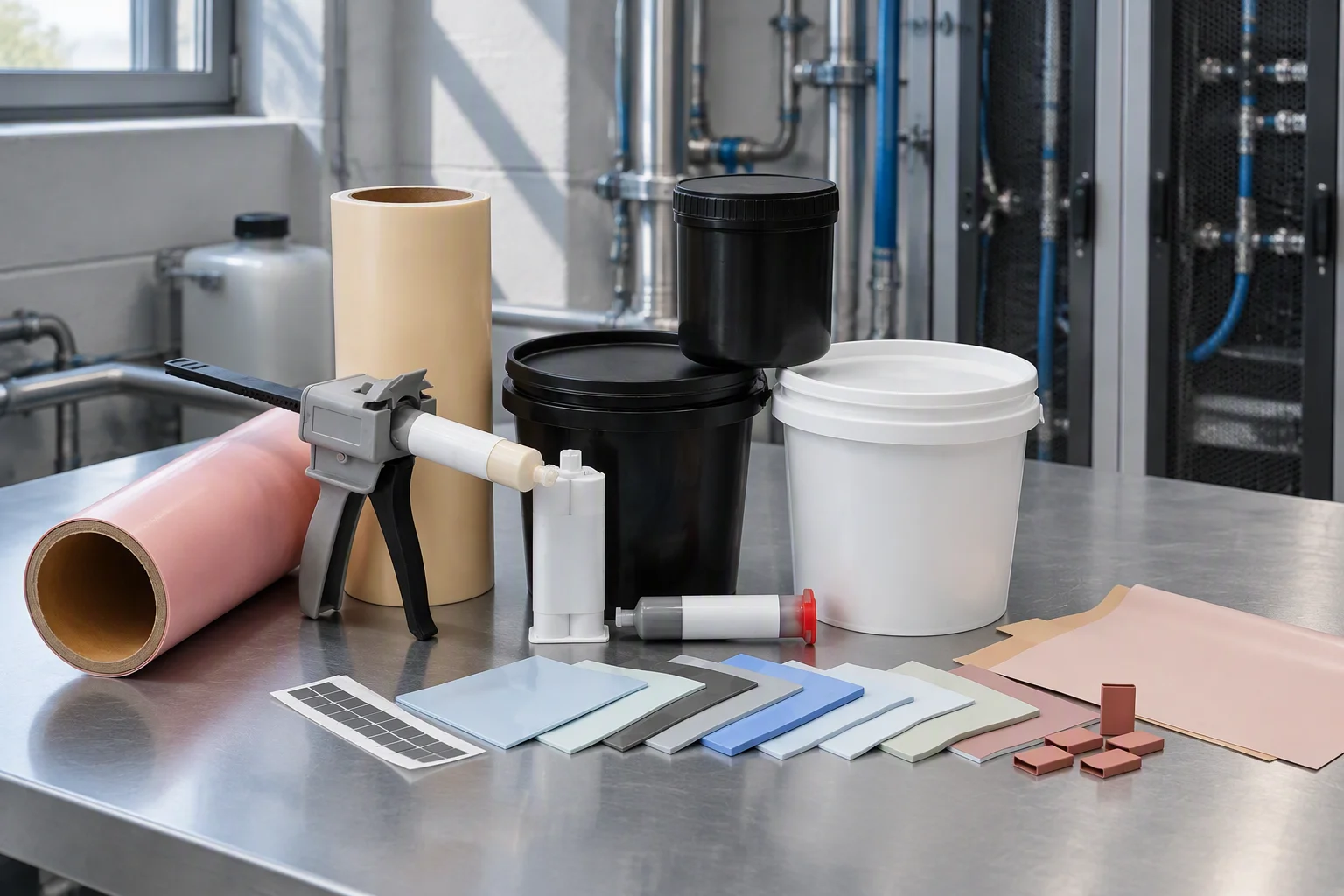
Maintenance bench holding a thermal pad sheet, a grease cup and a folded drawing

The bench · the consumables the posts are about

01 / The three posts

Route by the loop problem, not by the title

Numbers trace to a published datasheet, a standard or a named trade source, and each post says which. A vendor's own marketing figure is labelled as one.

How often should a liquid cooling loop be filtered?

The interval is not a date. Two loops of the same volume load an element at different rates, so the element changes out at its terminal differential pressure, not on a calendar. A side-stream loop diverts 5–15 % of circulating volume and returns it filtered, with a published guidance band of a full turnover every 6–12 hours; at 10 % per hour that is about 10 hours on a 4,800 L loop. Sampling is the other half of the rule: coolant every 50 to 100 days, from a hot closed loop rather than a drain point.

Filtration · 8 sections · about 890 words

Differential pressure against element life A rising differential pressure line crossing a change-out rule at 35 psid, below a maximum rule at 60 psid, starting near 2 psid clean. 0 days life 60 psid max 35 psid out 2 psid clean

Choosing leak detection for a secondary loop

A conductive sensing rope reports distance by measuring resistance between two wires, and that sentence decides what it can detect. Two figures decide whether an installation works: the fluid, where a blend of 15 % propylene glycol by weight or more conducts enough to be located, and the siting, where sensing cable inside a downflow air unit's discharge plume alarms on contamination and cannot be located. Position resolution is 0.1 m; locating repeatability is ±0.6 m plus 0.25 % of the whole channel. A near-deionised loop needs a different sensing principle, and no accessory fixes that.

Leak detection · 8 sections · about 985 words

Cable current with the contamination and leak setpoints A current axis in microamps with the contamination setpoint at 50 microamps, the leak setpoint at 150 microamps, and a contamination band from 1 to 300 microamps crossing the leak setpoint. 0 µA 300 µA 150 µA leak 50 µA cont. cont. band

Why thermal interface materials pump out

Grease leaves the bond line because the package and the cold plate expand at different rates. The failure is not a sudden one; it is measured in thousands of thermal cycles, and it is measured as dry-out, meaning weight loss below 0.2 % after 48 hours at 125 °C. A phase-change sheet softens across a 45–55 °C transition and stays in the gap instead of flowing out. A cured pad at 32 Shore 00 trades a little impedance for a bond line that cannot be squeezed thinner than it was specified.

Thermal materials · 8 sections · about 940 words

Bond-line impedance against thermal cycles Two curves over cycle count: a grease curve that rises steadily as it pumps out, and a phase-change curve that stays flat after its transition window. 0 cycles 1,000 grease, pump-out phase change

Why thermal interface materials pump out

02 / Sourcing and scope

What the catalogue covers, and what it does not

Sourcing standard

Every number traces to a published datasheet, a standard or a named trade source. Where the source is a vendor's own marketing figure, the post says that too.

Named in the post, not implied.

Revision convention

A post carries the revision year of every standard it cites and is revised when that standard is revised. No post is dated by when it was published.

Current as of its last revision.

Catalogue scope

The loop between the coolant distribution unit and the cold plate. Both of those parts sit outside the catalogue, and no post suggests otherwise.

CDU and cold plate excluded.

A post that raises a question about a loop gets answered from the loop, not from a catalogue line.

  • Every card above links into its own post, and every code named in a post has a PDF datasheet The filtration post carries the most codes. PDF
03 / Specification sheet

Send the loop, not a catalogue request

Fluid and glycol percentage, loop volume, operating temperature, and what changed recently. The reply returns the specification sheet and the datasheet for the code.

Specification request

Ask for the specification sheet

Leave your work email and the model code. One datasheet per model, with position resolution and locating repeatability stated as separate rows.

  • A specification table of at least ten rows per product family, and a downloadable PDF for every model listed.
  • Seal-life data where it decides the choice: permeation rate, compression set and fluid compatibility.
  • One working day for a reply, from an engineer rather than a catalogue autoresponder.
Reply within one working day