You own the loop and the SLA. You do not own the top-up can.
One party signs for the loop. Another party owns the container of fluid that goes into it, and the container arrives on a van.
Tenants top up with whatever is on hand, so conductivity and inhibitor state drift between maintenance visits. A drip in one tenant's rack is a whole-hall outage, and the fitting that produced it sits behind a locked door.
Sampling every 50–100 days, or quarterly

Colocation white space
Four numbers move between maintenance visits
Each band belongs to a loop type. Glycol is a weak electrolyte, so a premix loop and a de-ionised loop cannot share a target.
| Parameter | Target | Loop type | Why it is watched |
|---|---|---|---|
| Conductivity | 50–300 µS/cm | Glycol or facility water | Precedes corrosion. |
| Conductivity | 0.2–20 µS/cm | De-ionised technology cooling | Unreachable on a glycol premix. |
| pH | 7.0–9.0 | Glycol or facility water | The elastomer attack window. |
| pH | 8.0–9.5 | De-ionised technology cooling | Technology cooling side only. |
| Suspended solids | < 5 µm | Protection rating, cold plate | Abrasion feed for seal faces. |
| Chloride | < 50 ppm | Facility-water side | Main driver of closed-loop corrosion. |
| Chloride | < 5 ppm | Technology cooling side | Ten times tighter than facility water. |
A laboratory panel on hot closed-loop samples every 50–100 days shows which number moved first.
You cannot inspect a fitting inside a locked rack
Locate the first drip, and print the locating figures as separate parameters.
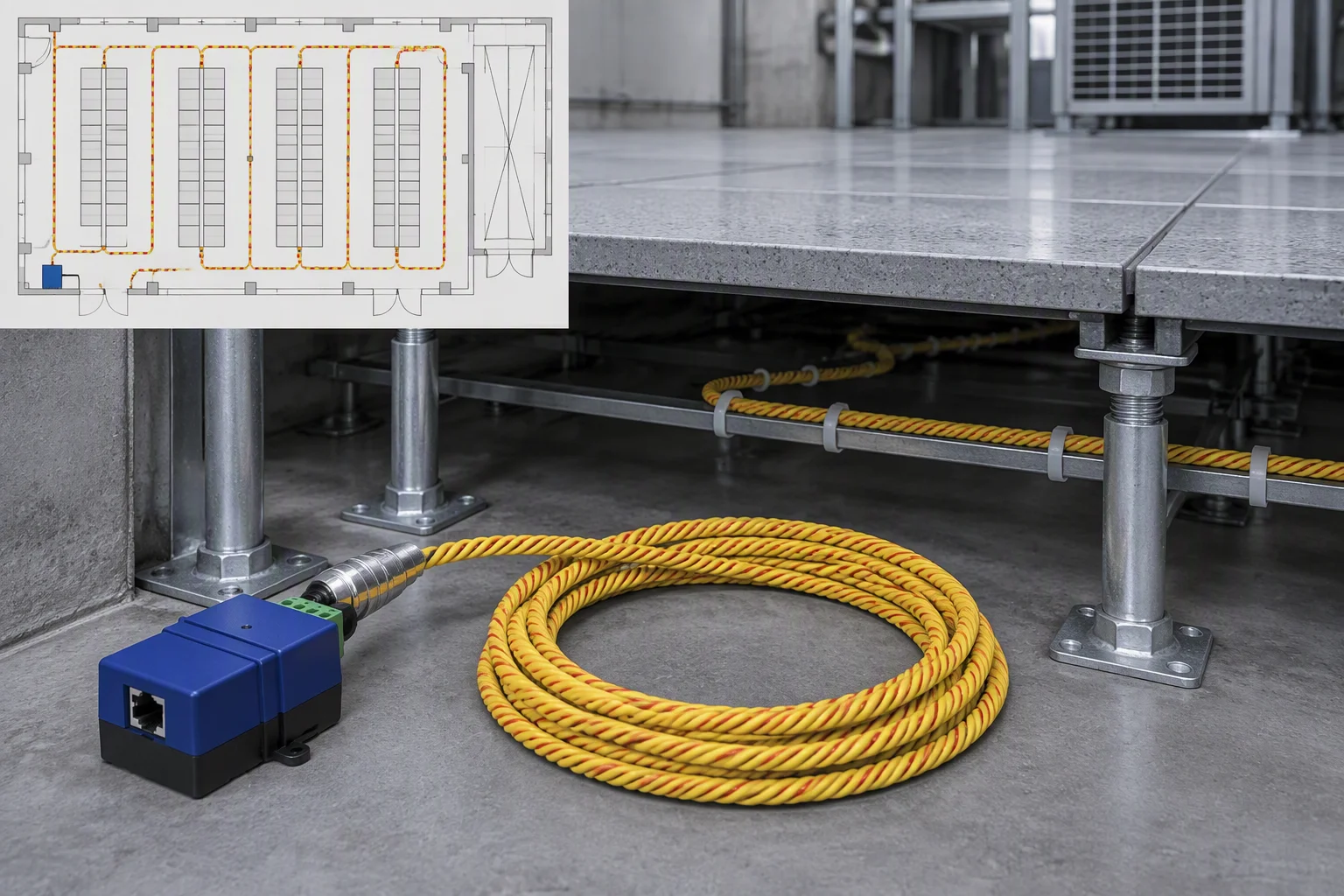
A distance-read controller reports where the cable is wet, so an unopened tenant rack can still be pointed at from the aisle. Two things decide whether that report is trusted: nuisance alarms from downflow air, and contamination currents.
| Position resolution | 0.1 m |
|---|---|
| Locating accuracy | ±0.6 m plus 0.5 % of cable length |
| Locating repeatability | ±0.6 m plus 0.25 % of cable length |
| Leak setpoint | 150 µA held 20 s |
| Contamination setpoint | 50 µA held 120 s, adjustable 25–300 µA |
| Contamination current | 1–300 µA |
| Drying after wet-wash cleaning | 6–48 h |
Contamination is the failure mode that looks like a leak. Solder flux and swarf draw 1–300 µA with no water present, which crosses the 150 µA leak setpoint.
Most liquid cooling here is added to a building that already exists
Retrofit and upgrade installation is the fastest-growing deployment category here, and retrofit complexity across legacy raised-floor, air-cooled facilities is named as the leading restraint. Brownfield immersion adoption sits at about 20 % for that reason.
A hybrid hall keeps supplemental air cooling on part of the thermal load, so the loop is an addition. Sensing cable then has to reach racks that were never planned for it.
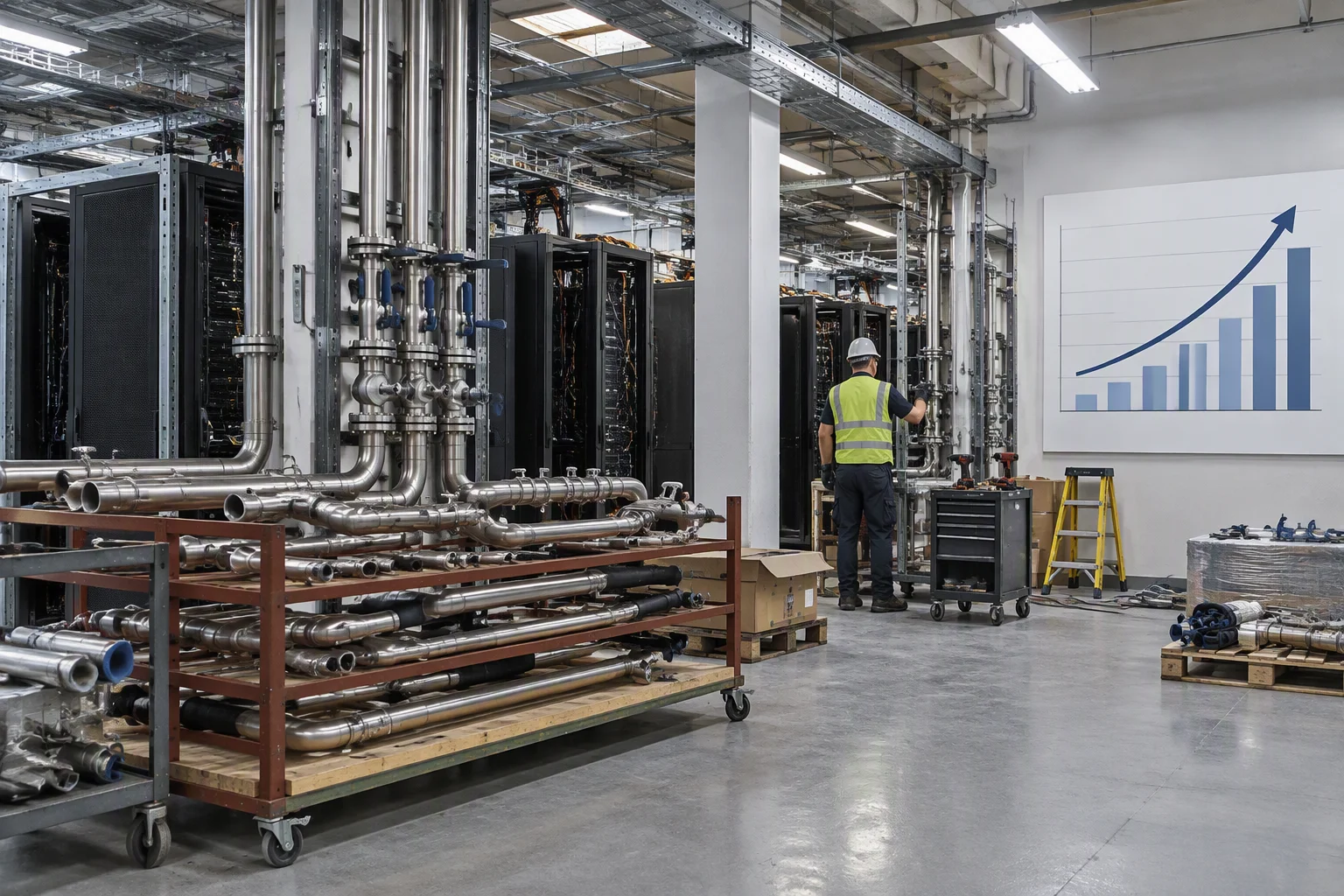
Deployment mode is stated as a fact about the market. The constraint is the building, not the labour.
Pick the model codes without leaving the page
One code per line, one PDF each.
| Product line | Model codes | Model codes |
|---|---|---|
| Leak detection | EMS-LD-R500 | EMS-LD-C16 |
| Filtration and water quality | EMS-CF-S10 | EMS-CF-WQ-C |
| Hose and fittings | EMS-HP-E8-20 | EMS-HP-FQD-04 |
| Thermal materials and telemetry | EMS-TM-P50-20 | EMS-TL-K300 |
Tell us the hall size, the coolant and the sampling interval
Send those three and the model code. We reply with the specification sheet, the conductivity band your loop type belongs to, and the lead time.