Thread stripping
Repeated make-and-break on the same thread, made worse by a coupling started by hand at an angle.
An installation here outlives three hardware generations. Every node swap is a disconnect and a reconnect on the same fittings, so the exposure is not age.
Repeated intervention is what makes an HPC loop leak more than its years suggest. Mixed generations sit on one manifold with different pressure drops, and a coupling opened a few hundred times is a different component from the one that was commissioned.
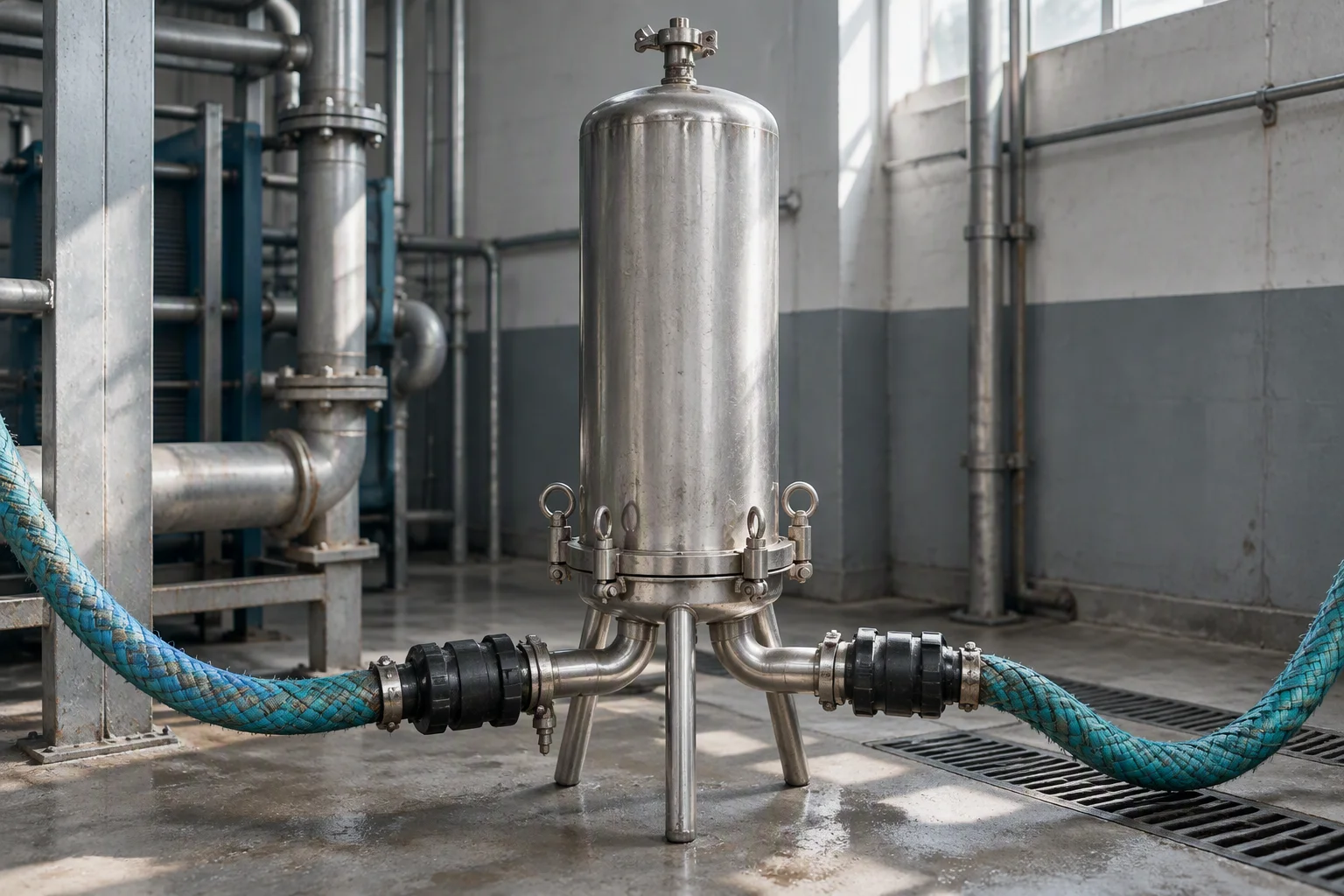
One loop, one set of fittings, three hardware refreshes.
A disconnect and a reconnect at the same coupling.
Different pressure drops sharing one manifold.
The four failure modes below are the published ones for quick disconnects in this duty. The hose is rarely the part that lets go.
Repeated make-and-break on the same thread, made worse by a coupling started by hand at an angle.
The seal takes a compression set, then releases on separation rather than holding through it.
Fluid leaves with the node instead of staying in the loop, which is what the dry-break figures below are written against.
The release sleeve stops travelling. The coupling is then opened with a tool, and the seal is destroyed in the process.
A non-spill coupling is specified to lose under 0.015 cc per disconnect at 0 psi and under 0.063 cc at 200 psi, with performance and leakage limits defined by ISO 18869 as a requirement the part is built to.
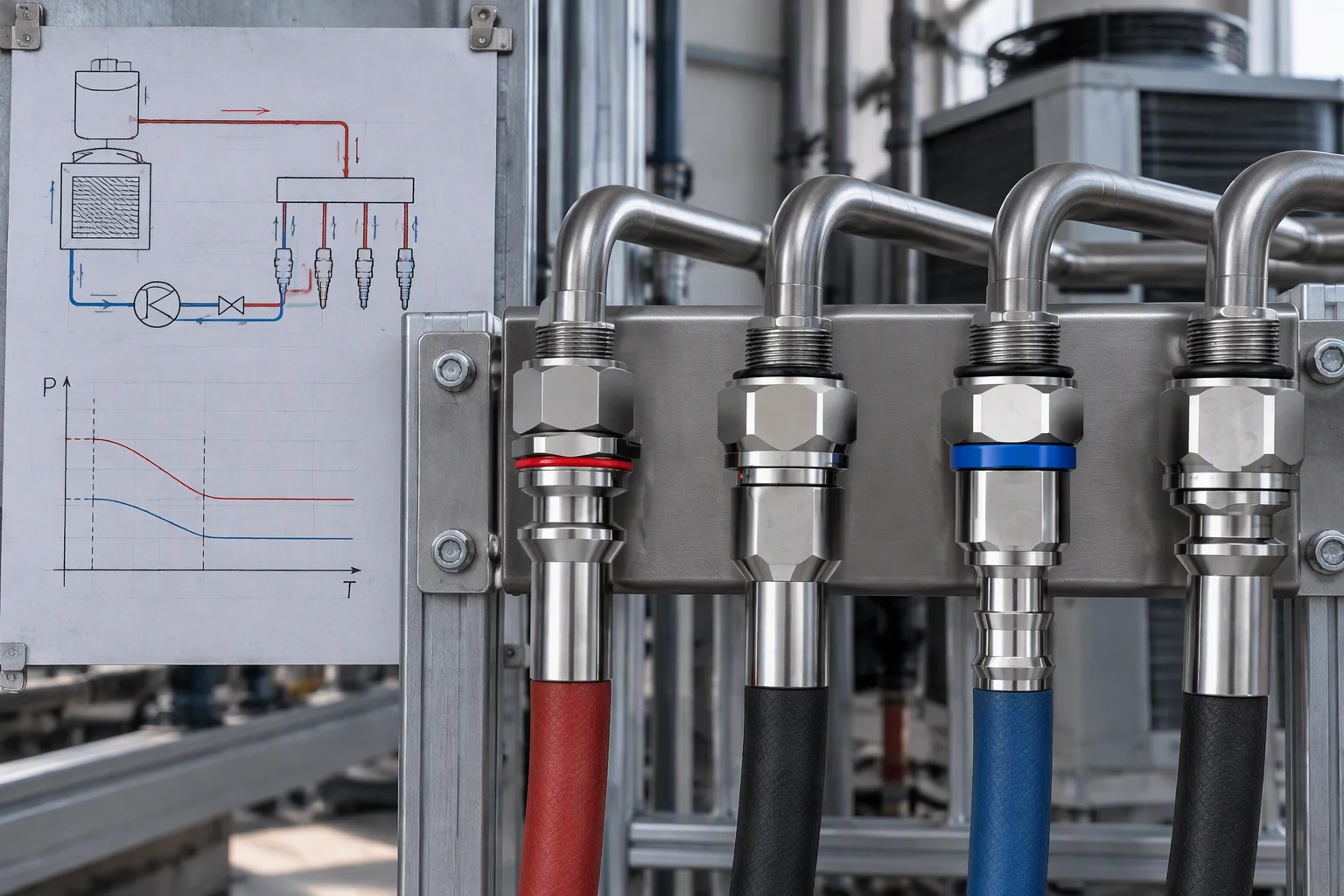
Non-metallic piping is now used for both facility water and technology cooling loops. Fusion-joined plastic is immune to dissimilar-metal corrosion and carries a better wear expectancy than copper or steel, which matters on a run that will be opened repeatedly for the next decade.
Negative pressure technology changes the detection problem rather than removing it. A compromised joint draws air in instead of pushing fluid out, so there is no puddle to find and the instrument has to read something else.
Under negative pressure the fluid stays inside the pipe and the air comes in, so a wet-floor sensor reads nothing. The loop still needs the same coverage; what changes is the quantity the instrument is asked to detect.
Bend radius is the specification that decides whether a jumper survives the next refresh. A hose forced below its published minimum has a shortened life, and the ferrule shows it later.
| Position | Dash or bore | Minimum bend radius |
|---|---|---|
| Rack-interior jumper | −4 | 24.5 mm |
| Rack-interior jumper | −8 | 69 mm |
| Row-level main | 1 in | 127.0 mm |
| Row-level main | 1½ in | 203.2 mm |
| Row-level main | 2 in | 304.8 mm |
No sulphur residues carried into the fluid.
Sulfur migrates into the fluid over time.
A cold-plate passage runs 100–300 µm wide; precipitated material narrows it.
Side-stream filtration and telemetry for the same duty travel as EMS-CF-S10 and EMS-TL-K300.
| Product line | Model codes | Model codes |
|---|---|---|
| EPDM hose | EMS-HP-E4-20 | EMS-HP-E8-20 |
| EPDM hose and jumpers | EMS-HP-E16-20 | EMS-HP-J4-06-QD |
| Jumpers and fittings | EMS-HP-J2-08-QD | EMS-HP-FQD-04 |
| Fittings | EMS-HP-FJC-08 | EMS-LD-R500 |
We reply with the specification sheets for the sizes you already run, the bend radii and the dry-break figures, within one working day.
Leave your work email and the model code. One datasheet per model, with position resolution and locating repeatability stated as separate rows.