Fill, flush and filtration for liquid cooling loops
A loop is cleanest the day it leaves the factory. Most particulate a filter catches enters on commissioning day.
0 at or above 50 µm · ≤5 000 at 15–25 µm · ≤350 at 25–50 µm, per 1 000 cm².
Cost of a loop out of service.
No coolant distribution units, no cold plates.
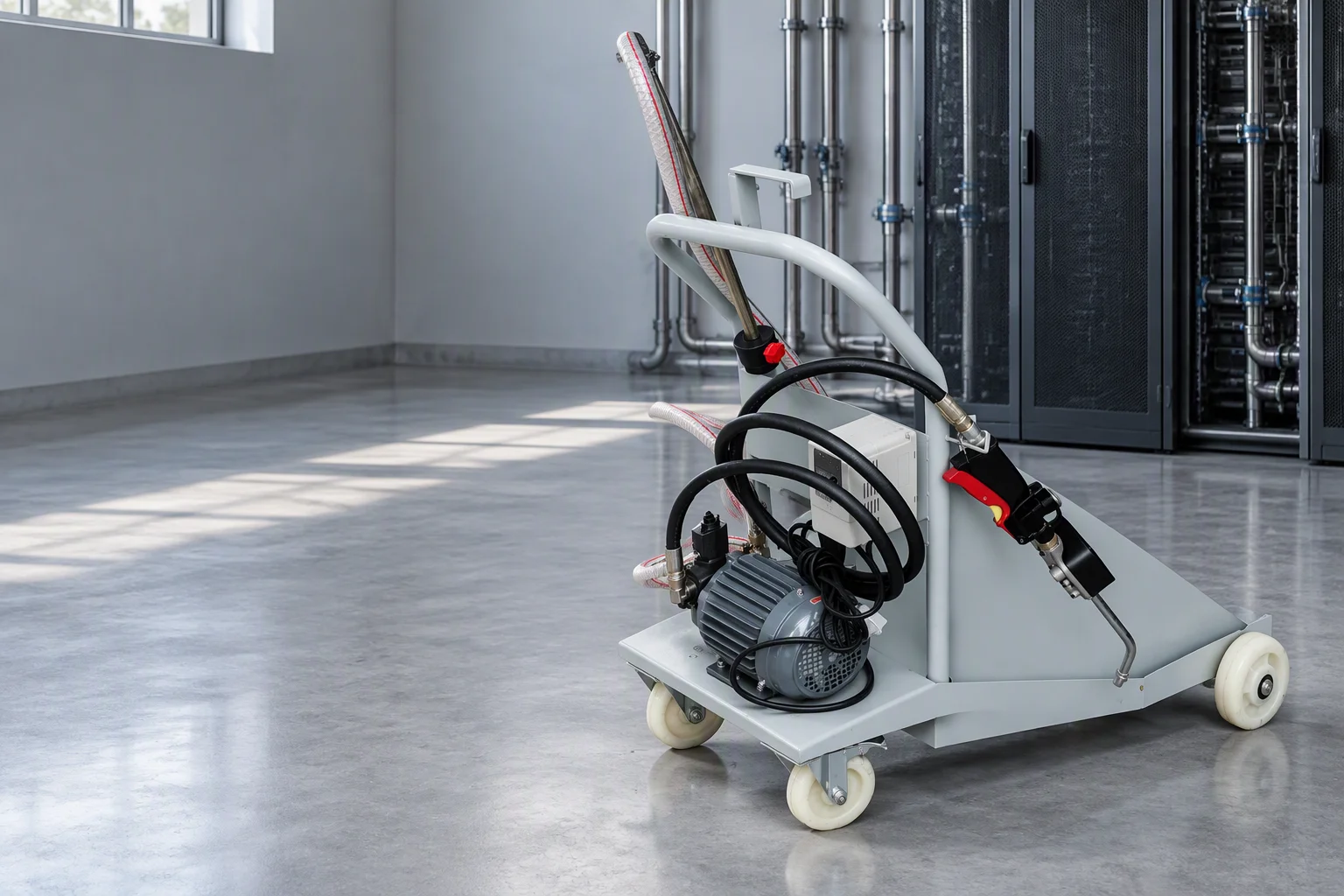
Fill cart landed on an open rack manifold
Four machines, in the order a loop meets them
Three ways a clean loop gets dirty
Municipal water carries particles a loop does not allow.
A wet filter retains contaminants, so replacement beats cleaning.
Drying air can dispense oil onto filter surfaces.
A thermal fill station carries an inline filter in its supply line.
The flush is a procedure with a stop condition
A procedure, not the protection rating of the filter that runs afterwards.
100 psig, 60 °C (140 °F).
The CDU sits outside the flush loop
| Item | Requirement |
|---|---|
| CDU as the flush pump | Avoided · contaminants reach its heat exchanger |
| Internal weld joints | Ra 0.5 microinch max |
| Passivation | ASTM A-380 · or 2 h at 60 °C, ASTM A-967 |
| Inlet strainer at a unit | 500 µm class · strainer rating, not a filtration stage |
The flush ends; filtration does not
| Placement | Multiplier |
|---|---|
| Full-flow filter | about 2× smaller · carries the whole flow |
| Side-stream filter | up to 10× smaller · carries a fraction of loop flow |
| Protection rating · absolute, not nominal | 7–10× smaller · a 50 µm passage takes a 5 µm filter |
The skid range routes to filtration skids.
Inhibited premix, or raw glycol
| Fluid | Corrosion |
|---|---|
| Inhibited propylene glycol, 40 % | 0.01 mpy |
| Raw uninhibited propylene glycol, 40 % | 23.65 mpy |
| Difference | 2 365× |
| Reserve alkalinity minimum, ASTM D1121 | 15.0 mL |
| Automotive antifreeze | Not acceptable in any fluid system |
25 % premix freezes at −10.1 °C. Viscosity runs 1.68 mPa·s at 15 % to 8.20 mPa·s at 55 %, at 20 °C.
Eighteen codes, one document each
| Model | Tank or flow | Sheet |
|---|---|---|
| EMS-FF-C120 | 120 L | |
| EMS-FF-C200 | 200 L | |
| EMS-FF-C500 | 500 L | |
| EMS-FF-FL75 | 75 L/min | |
| EMS-FF-FL340 | 340 L/min | |
| EMS-FF-FL1300 | 1 300 L/min | |
| EMS-FF-FS20 | 20 L/min | |
| EMS-FF-FS60 | 60 L/min | |
| EMS-FF-FS150 | 150 L/min | |
| EMS-CL-PG15 | 15 % · −5 °C | |
| EMS-CL-PG20 | 20 % · −7.2 °C | |
| EMS-CL-PG25 | 25 % · −10.1 °C | |
| EMS-CL-PG30 | 30 % · −13.3 °C | |
| EMS-CL-PG40 | 40 % · −22.2 °C | |
| EMS-CL-PG50 | 50 % · −35.0 °C | |
| EMS-CL-PG55 | 55 % · −43.3 °C | |
| EMS-CL-PGC | concentrate | |
| EMS-CL-DIW | 0 % |