Nobody is there when it starts leaking
On an unmanned site the expensive event is the visit, not the part. Nobody sees the first drip, so it is found by a fault. Detection here has to report, not merely sound a local alarm.
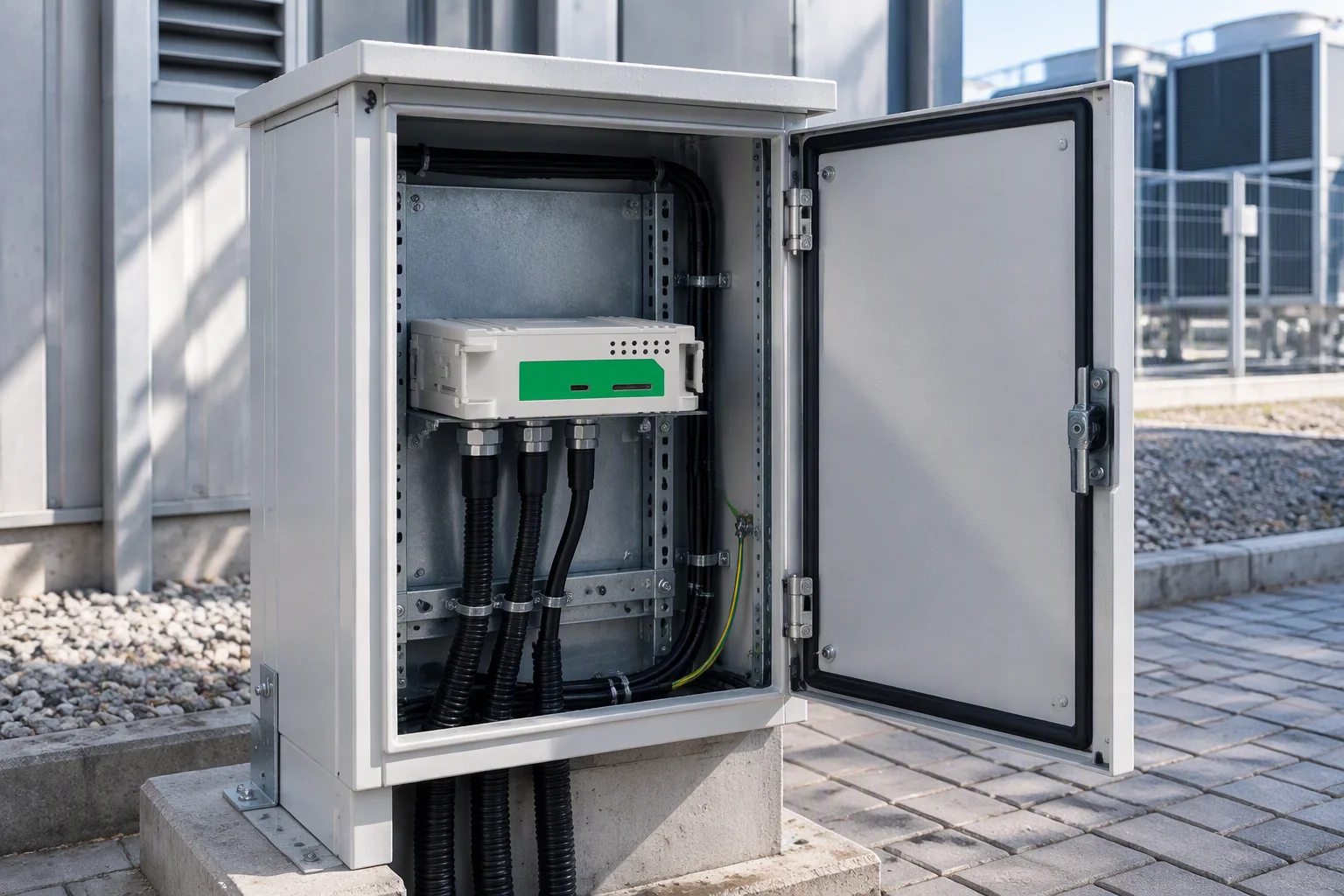
Street cabinet · service door ajar, cabling from below
You are buying the reporting chain, not the sensor
At a site with no attendant, what leaves the cabinet decides the model. The chain runs relay, then serial, then network.
| Stage | Signal | What it carries | Constraint |
|---|---|---|---|
| Form C | One Form C leak relay and one Form C cable-fault relay. | Alarm state only. No zone, no distance, no threshold change. | |
| EIA-485 | Two Form C leak relays, two Form C cable-break relays and a Modbus RTU server. | Each run needs its own pair of contacts. | |
| Network | Modbus RTU and TCP, BACnet MS/TP, BACnet/IP, SNMP v1, v2 and v3, NTP and SMTP. | Set thresholds and latching remotely, or the site decides when to drive out. |
A cabinet in direct sun cycles between two ranges every day
Ambient swing belongs on the hose schedule, not only on the sensing cable. The sensing cable is rated 0 to 75 °C. The hose carries its own published operating range and a wider storage range, and an edge cabinet cycles between them daily.
Ozone and UV cover ageing, tested by ASTM D1149. Hose held in a depot is bagged and stored away from ozone-generating equipment, with a shelf life of three years or more.
Reported response time: 5 to 990 s in 5 s steps, ±2 s on distance-read models. Fixed 10 s or 2 min at ±10 % on the single-zone class.
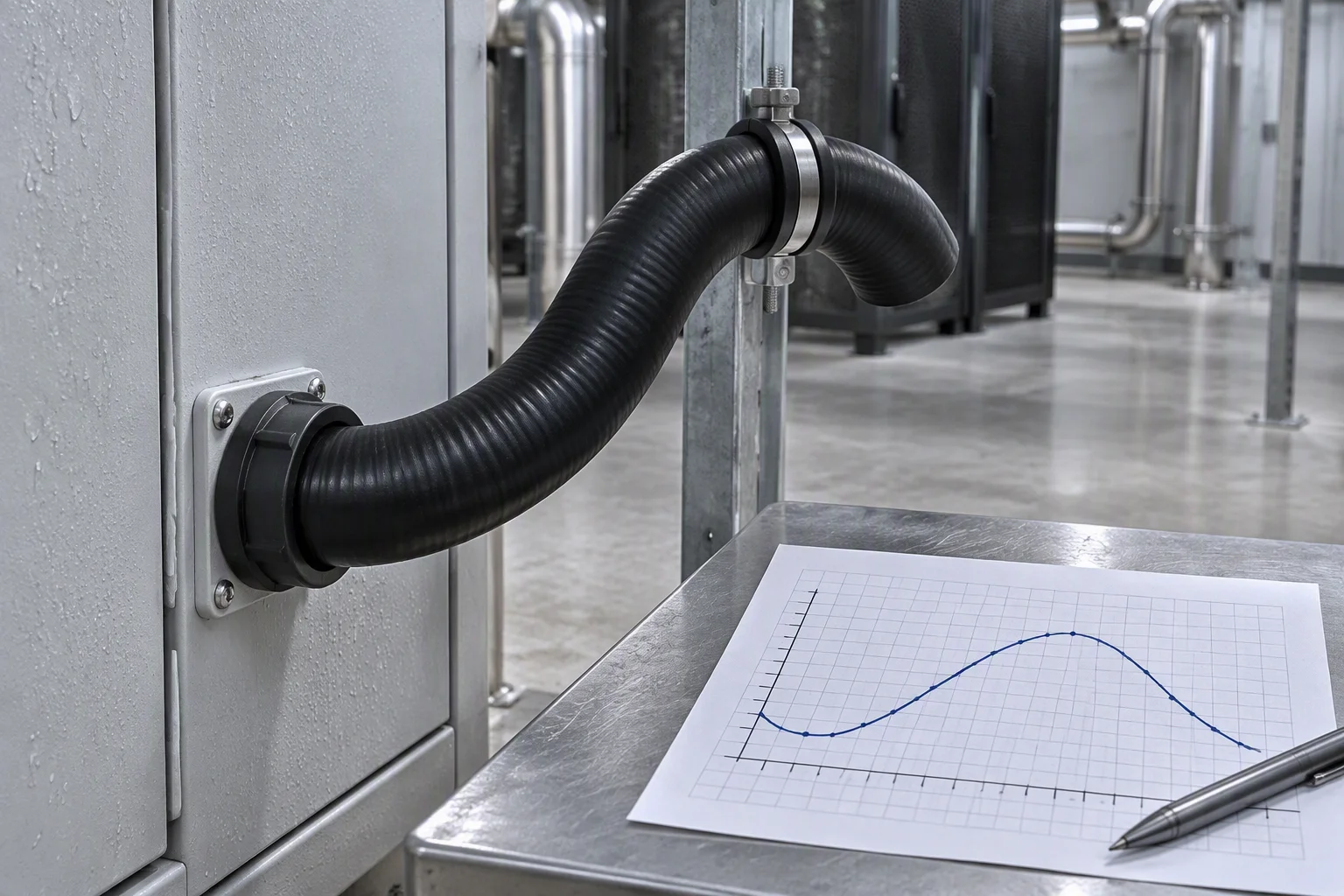
A monitored element, not a scheduled visit
Differential pressure read remotely turns the filter into an asset you watch. Change elements at 35 psid, inside the 60 psid collapse limit.
| Figure | Value | What it means at a cabinet |
|---|---|---|
| Change-out trigger | 35 psid | Read remotely, so the visit is booked on evidence. |
| Collapse limit | 60 psid | The element is changed well inside its own limit. |
| Past the threshold | Flow falls | The load runs warm before anything alarms. |
| Interval | Longest defensible | One visit every second year beats the cheapest element. |
Pick the codes without leaving the page
-
EMS-LD-C8 8-channel distance-read leak panel Serial and network reporting; thresholds set remotely. PDF
-
EMS-LD-C16 16-channel distance-read leak panel One panel per cabinet row; relay and serial both present. PDF
-
EMS-LD-R100 Locating sensing rope, 100 m Position resolution 0.1 m, stated separately from repeatability. PDF
-
EMS-CF-F5-20 Pleated depth cartridge, 5 µm nominal protection rating, 20 in The element sized for the longest defensible interval. PDF
-
EMS-CF-FP-DP Element differential-pressure monitor, 2 psid clean to 60 psid The reading that replaces the scheduled visit. PDF
-
EMS-HP-E10-20 EPDM hose, −10 dash (5/8 in), 20 m coil Operating range beside a wider storage range on the same sheet. PDF