A side-stream unit diverts a fixed share of the loop through a filter and returns it downstream of the take-off
Five divert setpoints, 5% to 15% of loop volume.
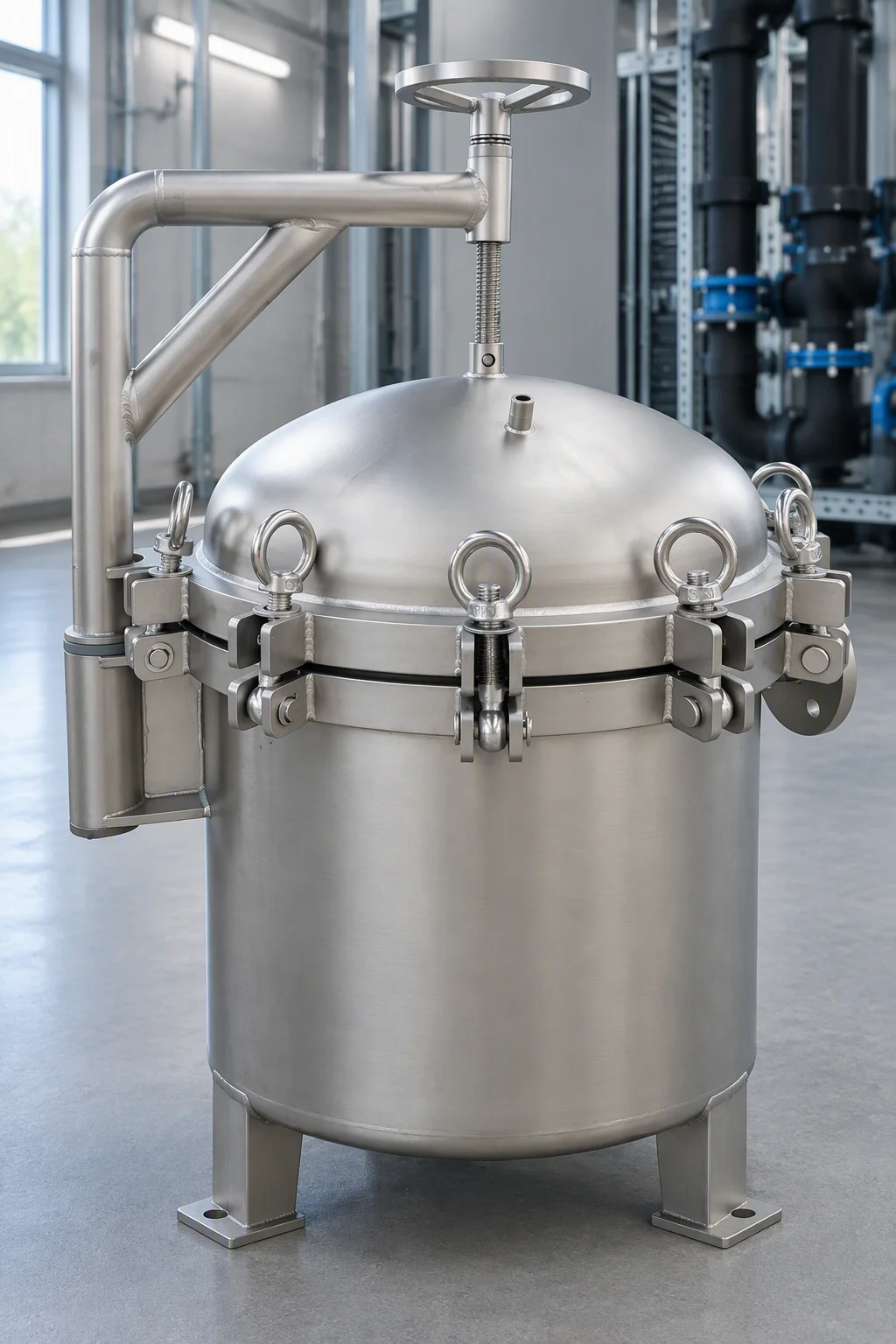
Multi-bag vessel, 150 psi.
10.3 bar.
At 10% per hour.
Max 60 psid.
Full-flow inline filtration of a facility's whole flow demands excessive energy and a large footprint. A side-stream element is sized about 10× the required protection rating, against 2× full-flow.
Five codes across the divert band
The number in the code is the divert setpoint; all five use fixed orifice trim, and S10 is the published turnover example.
| Parameter | Value |
|---|---|
| Divert band | 5–15% of loop volume |
| Vessel pressure | 150 psi, 10.3 bar |
| Flow per hole | 150 gpm, 34 m³/h |
| Fine stage | 5–40 µm protection rating |
| Coarse guard | 100–200 µm strainer rating |
| Alloy | 316L |
| ΔP change-out | 35 psid, 2.4 bar |
| ΔP maximum | 60 psid, 4.1 bar |
| Seals | NBR, EPDM, FKM |
Metal cloth or pleated depth
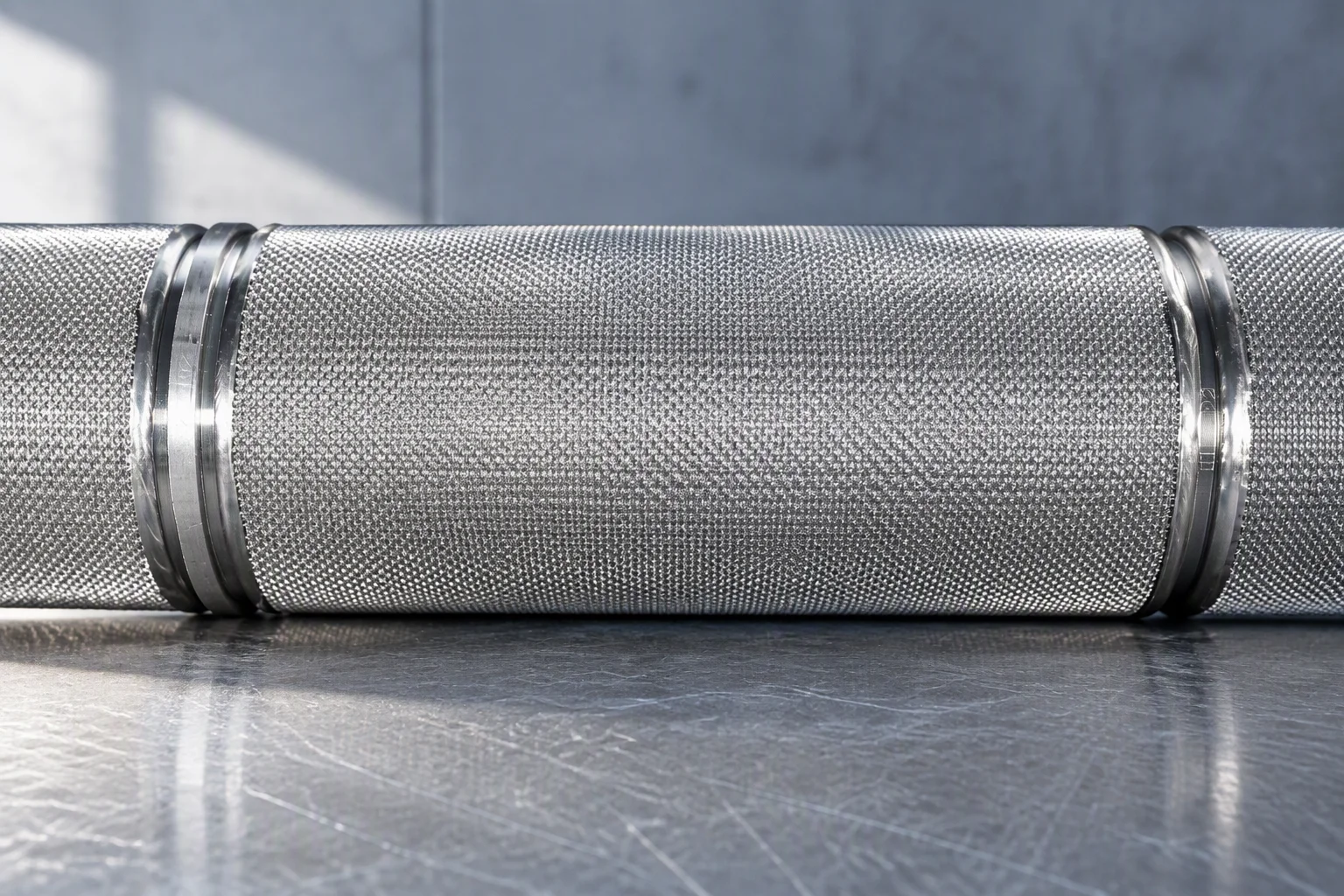
Metal filter cloth
- 5–40 µm protection rating.
- 316L sinter-bonded mesh, backwashable.
- Reverse plain Dutch weave, 2× conventional flow.
- Plain weave at 100–200 µm is a strainer rating.
PP pleated depth
- Media, support, caps, core and cage all PP.
- The fine polishing stage, downstream.
- Disposable, for low loading.
- Upstream of both: the inlet strainer is a 500 µm strainer rating protecting the pump.
Sizing from the turnover target
Side-stream flow = share ÷ 100 × loop circulating volume.
| Share per hour | Turnover | Band position |
|---|---|---|
| 8.3% | 12 h | Slow end |
| 10% | 10 h | Mid-band example |
| 16.7% | 6 h | Fast end |
Worked example. A loop circulating 60 m³/h at 10% gives 6.0 m³/h, calculated: 1.66 L/s, the top of the compact flow-meter band.
Where the take-off and the return go
| Element | Rule |
|---|---|
| Take-off | Header, upstream of loads |
| Return | Downstream of the take-off |
| Pump | Dedicated |
| Venting | Every high point |
| Avoid | Traps, dead legs, inverted U-bends |
| Divert confirmation | Branch meter, ±0.75% of rate |
Entrained air cuts heat-transfer effectiveness, cavitates pumps and accelerates corrosion, so air problems appear weeks after start-up.
The number each instrument triggers
Download the EMS-CF-S10 specification sheet PDF| Measurement | Number it triggers |
|---|---|
| 35 psid, 2.4 bar; max 60 psid at 20 °C | |
| 5–15% split; ±0.75% of rate | |
| de-ionised 0.2–20; glycol-premix 50–300 µS/cm | |
| de-ionised 8.0–9.5; glycol-premix 7.0–9.0 | |
| Below 1 NTU |
A clean 2 µm protection rating starts at 0.17 bar, 2 psid.
What a side-stream unit is not
These codes cover a vessel, a pump and an element on the loop header. Filtration inside a coolant distribution unit is its maker's scope; where a CDU carries its own filter, this unit runs in parallel, sized on loop volume.
150 psi, 10.3 bar · proof test 1.5× = about 15.5 bar · IEC 62368-1
The company integrates, inspects, stocks and ships; it does not build the vessel.
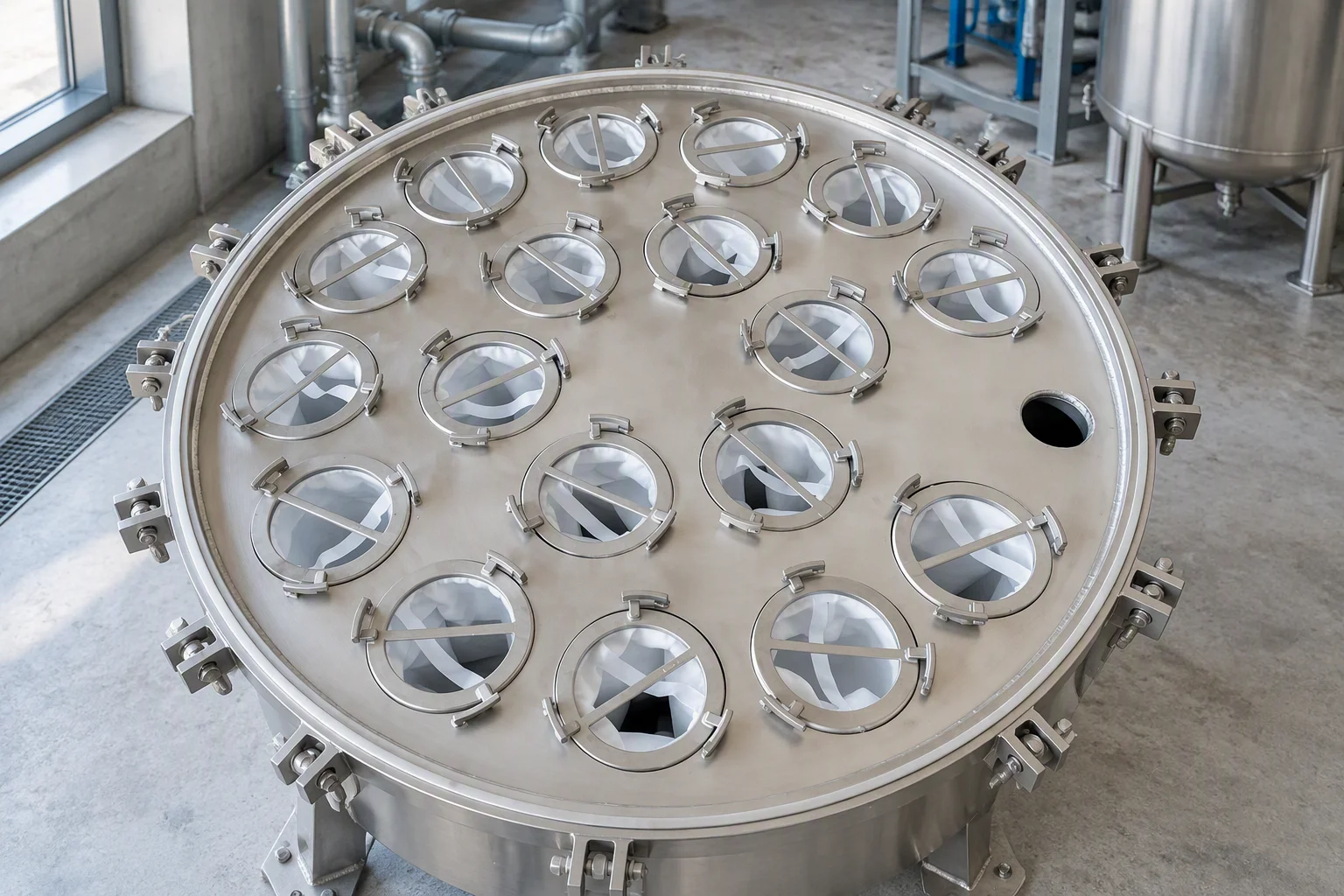
Housing tubesheet, no cabinet in frame.
Eight codes, one sheet each
| Code | Rating |
|---|---|
| EMS-CF-S05 | 5% divert |
| EMS-CF-S08 | 8% divert |
| EMS-CF-S10 | 10% divert |
| EMS-CF-S12 | 12% divert |
| EMS-CF-S15 | 15% divert |
| EMS-CF-F100-10 | 100 µm, 10 in |
| EMS-CF-F10-20 | 10 µm, 20 in |
| EMS-CF-F5-40 | 5 µm, 40 in |
The three element ratings are protection ratings. The five unit rows are identical across the family, so a code change never changes the vessel rating.