Coolant quality targets
Eight parameters cover a single-phase loop: four chemistry, four physical. Two published band sets print below, describing different loops rather than disagreeing.
| Chemistry | Physical |
|---|---|
| pH | Suspended solids |
| Conductivity | Turbidity |
| Chloride | Dissolved oxygen |
| Hardness | Microbial state |
Glycol is a weak electrolyte, so a PG25 loop cannot sit at 5 µS/cm and a de-ionised loop cannot sit at 300 µS/cm.
Four bands, printed for both loop types
| Parameter | Glycol or facility water | De-ionised technology | Basis |
|---|---|---|---|
| pH | 7.0–9.0 | 8.0–9.5 | Inhibitor effectiveness; mixed metallurgy tightens it |
| Conductivity | 50–300 µS/cm | 0.2–20 µS/cm | Glycol content; ionic load drives galvanic attack |
| Chloride | below 50 ppm | below 5 ppm | Pitting at stainless steel |
| Total hardness | below 50 ppm | below 20 ppm | Scale on heat-transfer surfaces, as CaCO₃ |
The four a seal feels
| Parameter | Band | Mechanism |
|---|---|---|
| Suspended solids | below 3 ppm · protection rating below 5 µm cold plate | Blockage above half the width of a 100–300 µm channel |
| Turbidity | below 1 NTU working target | Optical proxy for particulate ahead of the element |
| Dissolved oxygen | below 2–4 mg/L | Consumes inhibitor, drives corrosion |
| Microbial state | below 100 CFU/mL · zero active growth | Biofilm insulates surfaces, shelters corrosion |
The ASHRAE technology-cooling table prints turbidity below 20 NTU; field guidance uses 1 NTU. The suspended-solids figure is a protection rating, not a flush step.
One failure at one place
| Out of band | Consequence | Shows in |
|---|---|---|
| Particulate | Seal-face abrasion, groove wear | weeks |
| Chloride | Pitting at stainless fittings | months |
| Conductivity | Galvanic current at mixed-metal joints | months |
| pH | Elastomer swell, faster compression set | weeks |
| Hardness | Scale on the seal land | months |
| Dissolved oxygen | Oxide debris in the seal groove | months |
| Microbial growth | Biofilm under the gasket | months |
A sample that means something
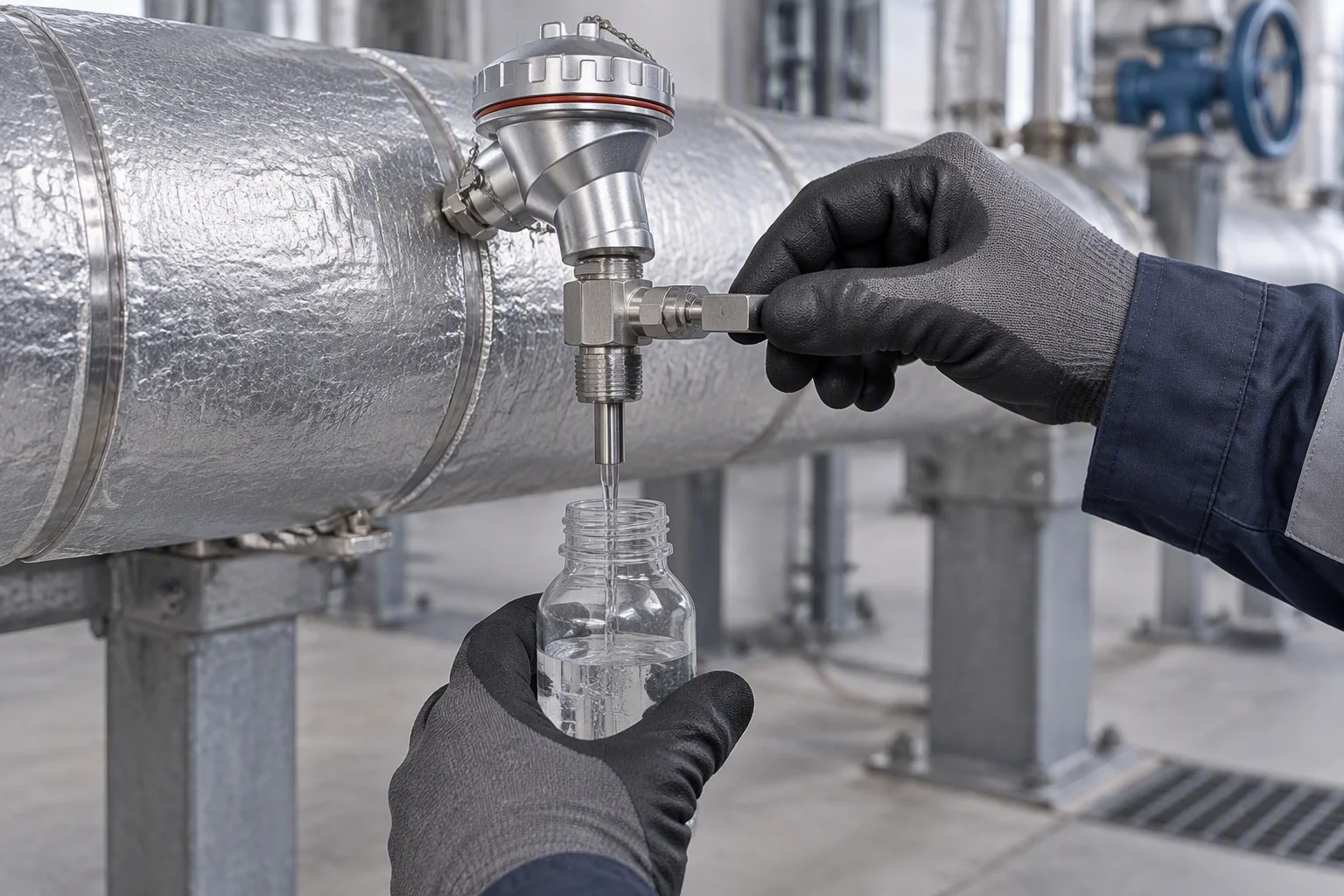
Sample the hot, closed loop. A drain valve reads the wrong fluid.
| Item | Value |
|---|---|
| Laboratory panel | every 50–100 days, or quarterly |
| Also verify | Initial fill, after make-up, after a vacuum fill |
| Reserve alkalinity | ASTM D1121 |
| Conductivity | ASTM D1125 |
| Freeze point | ASTM D1177 |
| Corrosion | ASTM D1384 |
| Elastomer swell | ISO 1817 |
What an out-of-band number means at 02:00
| Reading | Likely cause | First move |
|---|---|---|
| Conductivity up, pH steady | Ionic ingress from make-up water | Switch to deionised make-up, re-sample in 7 days |
| pH below band | Inhibitor depletion | Laboratory panel, reserve alkalinity by ASTM D1121 |
| Turbidity above 1 NTU | Element break-through | Check seating; change at 35 psid |
| Chloride above band | Make-up water or upstream corrosion | Stop automatic make-up; sample up and downstream |
| Hardness above band | Untreated make-up or evaporation | Verify dilution water before topping up |
Absolute, 7–10× smaller than the finest channel
| Figure | Category |
|---|---|
| 7–10× smaller than the finest channel | Protection rating, so a 50 µm passage takes a 5 µm element |
| about 2× full-flow · about 10× side-stream | Protection rating, by element position |
| 100 → 50 → 25 µm | Commissioning staging, not a product specification |
Nominal media is quoted at 90 % retention; absolute media reaches 99.98 %. Side-stream filtration polishes 5–15 % of circulating volume, a full turnover every 6–12 hours. Elements change at 35 psid, inside the 60 psid collapse limit. The 500 µm class is a strainer rating at a unit inlet.
Buy the measurement, not only the band
EMS-CF-WQ-PH for pH, EMS-CF-WQ-NTU for turbidity, EMS-CF-WQ-PC for particle counting, EMS-CF-FP-DP for filter differential pressure, EMS-CF-FP-FL for flow. Conductivity is EMS-CF-WQ-C at cell constants 0.01 and 0.1 cm⁻¹: 0.04–200 µS/cm, spanning both loop types.