Hose and fitting selection
Temperature and pressure ratings are the two numbers buyers check and the two that least predict failure.
| Decision | Controls | Leaves open |
|---|---|---|
| Fluid extraction at the tube | The pressure held | |
| Burst margin, bend radius, vacuum collapse | Fluid compatibility | |
| Whether the joint weeps or holds | The hose's own life | |
| Surge and water hammer | Seal-face condition |
Cure system is a specification line
| Item | Value |
|---|---|
| EPDM polarity | Non-polar hydrocarbon elastomer |
| Good in | Water, glycol, phosphate esters |
| Poor in | Hydrocarbon oils |
| Sulfur cure | Introduces sulfate; shows as chemistry drift |
| Peroxide cure | The specified alternative |
| Test to ask for | ISO 1817 — swell, mass change |
| Hardness designation | EPDM 70, meaning 70 Shore A |
Ask for the immersion report rather than a compatibility chart. A UL 94 V-0 cover is a claim to verify per item.
Construction follows loop position
| Duty | Reinforcement | Bore | Minimum bend radius | Working pressure |
|---|---|---|---|---|
| Rack-interior jumper | One fibre braid layer | −4 to −10 · 6.1–16.6 mm | 24.5 mm at −4 · 69 mm at −8 | 1.38 MPa · 200 psi |
| Row-level main | One or two braid layers | −16 to −32 · 25.4–50.8 mm | 127.0 / 203.2 / 304.8 mm | 1.38 MPa · 200 psi |
| Negative-pressure duty | Composite braid | −16 to −32 | See row main | 1.38 MPa · 200 psi |
Standard braid collapses under the negative pressure of a pump stop-start; composite reinforcement stops it. Installing below the published bend radius shortens hose life.
Where the joint will fail
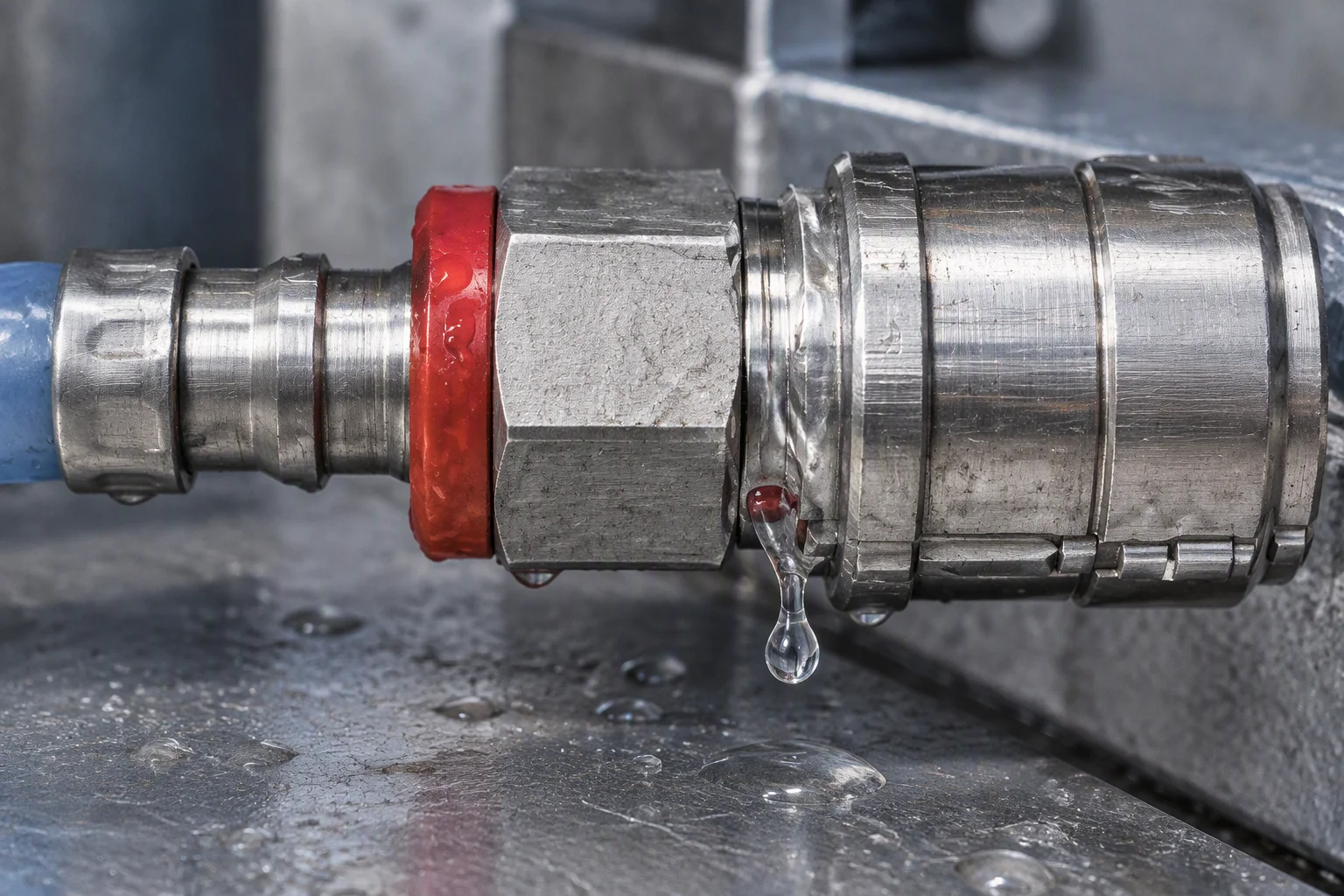
A crimped, swaged ferrule removes the clamp from the assembly. A clamped joint holds by stored stress while EPDM cold-flows under compression, so at 1.38 MPa with daily thermal swings a creeping clamp weeps rather than bursts.
| Item | Value |
|---|---|
| Non-spill coupling, 0 psi | under 0.015 cc per disconnect |
| Non-spill coupling, 200 psi | under 0.063 cc per disconnect |
| Performance standard | ISO 18869 |
| Interface envelope | UQD and UQDB, blind-mate variants |
Burst margin is a floor
Against maximum allowable working pressure.
5.5 MPa burst against 1.38 MPa working.
Relief valves set below the rated maximum.
Burst testing to ASTM D1599 uses deionised water or PG25 with all air purged first, because a compressible charge turns a rupture into an explosion.
Per material group and size, or not at all
| Family | Standard | Rating basis |
|---|---|---|
| JIC 37° flare | SAE J514 · J516 | About 3,000–5,000 psi in steel, lower in 316 stainless |
| BSPP (G) thread | ISO 228-1 | 10–16 bar typical, washer or O-ring dependent |
| Camlock | MIL-C-27487 · A-A-59326 | 250 psi class in aluminium and brass, gasket dependent |
| Flange adapter | ANSI B16.5 | 285 psi at ambient, de-rated with temperature |
| UQD and UQDB | OCP envelope · ISO 18869 | Minimum burst at least 3× maximum allowable working pressure |
Eight lines a hose inquiry needs
Bore and OD
Working and minimum burst
Operating range
Peroxide or sulfur
Per item
Per dash size
Type and material
Storage included
Two figures to ask for rather than assume. A defensible target is 10 % or less volume swell and 5 % or less mass change after 168 hours at 70–100 °C, in an ISO 1817 report at PG50 and verified against that report rather than quoted as our limit. The ASTM D2000 line callout encodes hardness, tensile strength, heat ageing and fluid resistance in one code.
Close on the specification pack
Hose: EMS-HP-E4-20, EMS-HP-E8-20 and EMS-HP-E16-20, peroxide-cured EPDM with fibre-braided reinforcement. Jumpers: EMS-HP-J4-06-QD with a non-spill quick disconnect at each end. Fittings: EMS-HP-FQD-04 and EMS-HP-FBT-06.