Graphene pads — two conductivities, two columns, never one
One pad, two measurements on two axes.
Ask for the specification sheet
| Property | In-plane |
|---|---|
| Top figure | 130 on oriented pads; 1 450 on films 40–2 000 µm |
| What it describes | Conduction along the plane of the sheet |
| Comparable with | Other in-plane figures only |
| Property | Through-plane |
|---|---|
| Published range | 0.8 to 15 across the compliant pad range |
| What it describes | Through the thickness, the path in a stack |
| Comparable with | Grease, pad and phase change figures |
A through-plane figure is comparable with a grease or pad figure. An in-plane figure is not, and this site does not print them side by side.
One pad drawn twice
Along the plane of the sheet.
Through the thickness.
No shared column, no shared chart, no shared sentence.
Buy from the through-plane ladder
| Model | Through-plane, W/m·K | In-plane | mm |
|---|---|---|---|
| EMS-TM-GR30 | 3.0 | not quoted | 0.25–3.0 |
| EMS-TM-GR50 | 5.0 | not quoted | 0.25–5.0 |
| EMS-TM-GR80 | 8.0 | not quoted | 0.50–6.0 |
| EMS-TM-GR120 | 12.0 | not quoted | 0.50–6.0 |
| EMS-TM-GR150 | 15.0 | not quoted | 0.50–6.0 |
Oriented grades are quoted against drawing; their datasheets print the in-plane figure in its own column.
It recovers, so it stays in contact
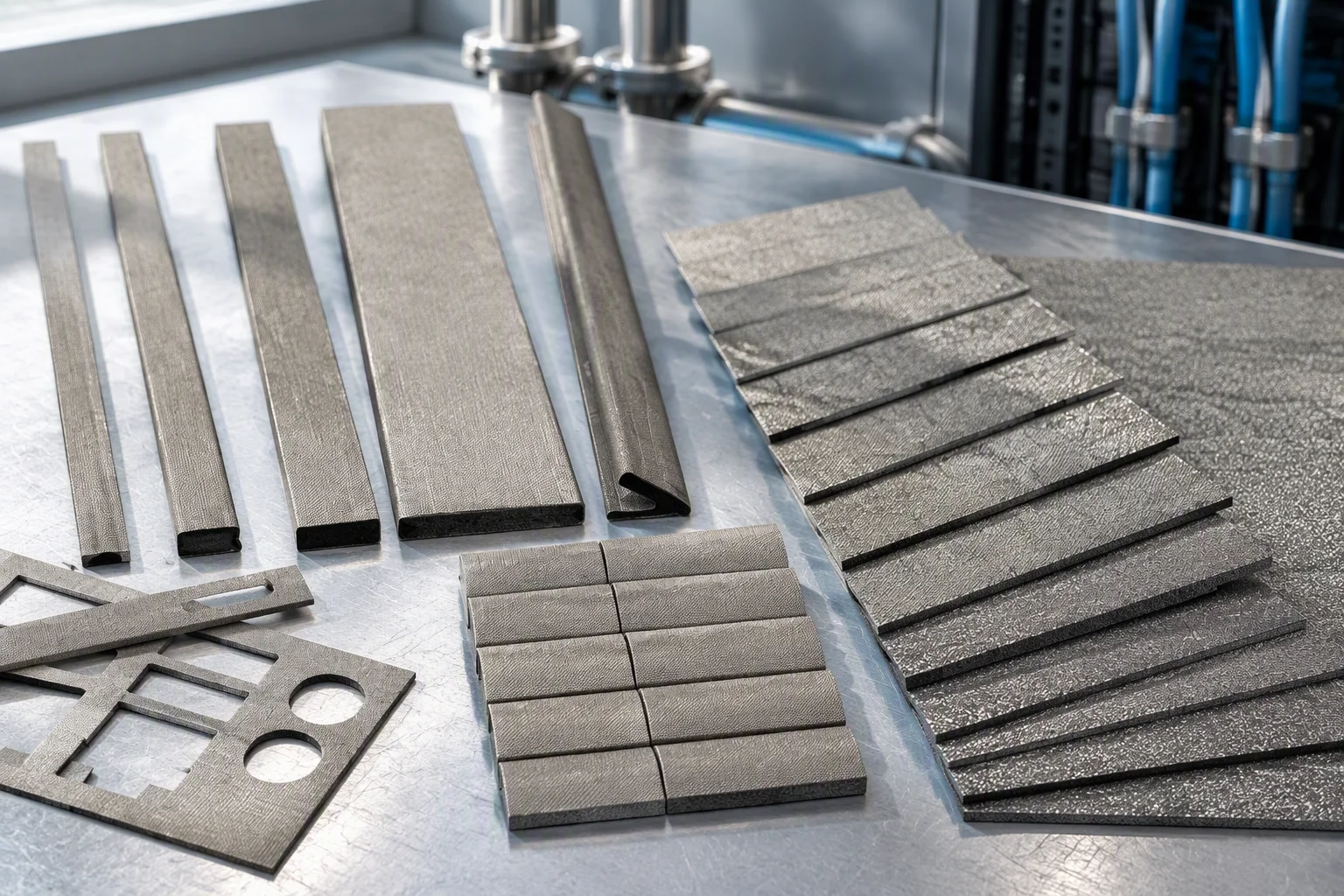
Oriented graphene pads are published with 70 % rebound resilience. Dry solid-to-solid contact touches under 3 % of the apparent area, so a pad that springs back keeps filling it.
Thickness across the class is 0.25–20 mm, so the same material covers a 0.25 mm film and a 20 mm pad.
Glue points change the thermal path
The number of glue points on the pad surface measurably changes its interface thermal resistance, documented by a supplier experiment on one of these grades. More adhesive means easier pick-and-place and a worse thermal path.
The datasheet states the glue-point pattern and its count; the drawing shows where the points sit.
What is declared, and what is not
Declared free of oil bleed.
Silicone pads are measured at ≤ 1 % by Φ30 mm filter paper.
RoHS at 0.1 %; cadmium at 0.01 %; 240+ SVHC substances including D4, D5 and D6.
On request
ASTM E595; comparable figures TML 0.170 % and CVCM 0.010 %.
On request
No flame rating is published for these grades, so UL 94 V-0 is quoted per drawing.
What the graphene datasheet carries
| Row | Unit | Method or basis |
|---|---|---|
| Model code | — | EMS-TM-GR30 … GR150 |
| Through-plane conductivity | W/m·K | ASTM D5470 |
| In-plane conductivity | W/m·K | own column; oriented grades |
| Orientation and axis note | — | which axis each figure is on |
| Thermal resistance | °C·cm²/W | ASTM D5470 |
| Test pressure and thickness | psi, mm | stated per model |
| Thickness range and tolerance | mm | ASTM D374, plus drawing |
| Rebound resilience | % | 70, oriented grade |
| Hardness and compression | Shore 00 | ASTM D2240 |
| Adhesive glue-point pattern | count | per drawing |
| Operating temperature | °C | IEC 60068-2-14 |
| Oil bleed and outgassing | — | declared free |
| Compliance | pass / fail | RoHS, REACH, halogen |
A W/m·K figure without its test pressure and its thickness is not a specification.
Send the model code and the target
No coolant distribution units, no cold plates. Send the model code, the target through-plane W/m·K and the gap in mm. You get both conductivity columns with their test conditions, the drawing and the lead time.