Phase change materials, set by their transition window
45–55°CTransition window, DSC to ASTM D3418.
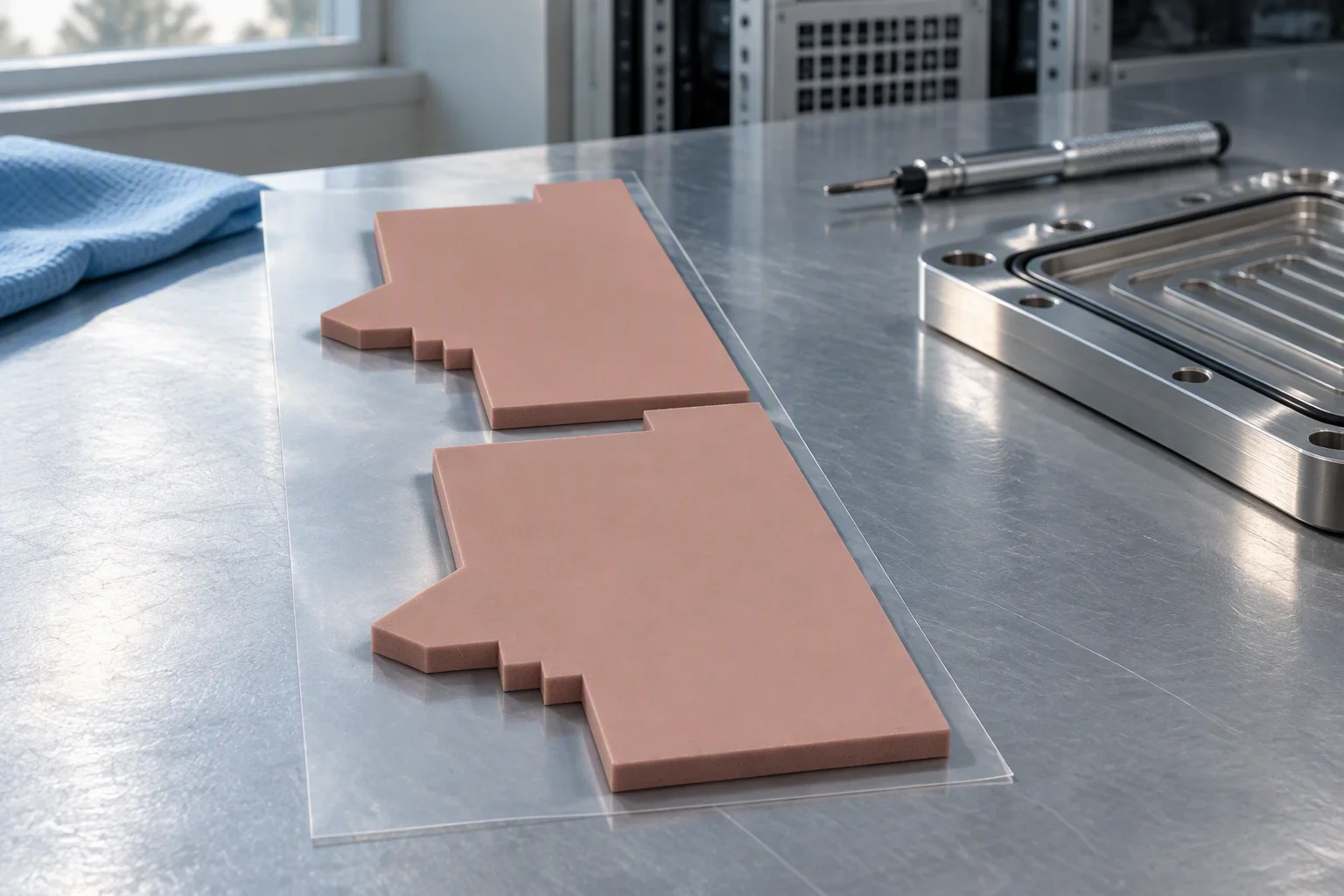
Solid and pad-like at room temperature; it softens above a set temperature and stays conformal, supplied 0.20–1.0 mm thick.
- Anchor grade: 2.4 g/cc by ASTM D792, −40 to +125 °C by IEC 60068-2-14, flame rating UL 94 V-0.
- The window is fixed by the formulation, not by the assembly.
Pump-out is the grease failure mode
A paste is pumped out of the bond line by CTE mismatch between die or lid and cold plate, over thousands of thermal cycles. A phase change material softens in place instead of flowing away.
The published selection warning asks the buyer to confirm pump-out risk, thermal cycling, storage and re-assembly.
Sealing reliability rather than heat rejection is the operating-time risk: pump-out is correct on assembly day and moves across thousands of cycles at a 0.05 mm bond line.
Order by conductivity and resistance
| Model | W/m·K | Resistance, °C·cm²/W |
|---|---|---|
| EMS-TM-PC20 | 2.0 | ≤ 0.020 |
| EMS-TM-PC30 | 3.0 | ≤ 0.015 |
| EMS-TM-PC40 | 4.0 | ≤ 0.012 |
| EMS-TM-PC50 | 5.0 | ≤ 0.010 |
| EMS-TM-PC60 | 6.0 | ≤ 0.009 |
| EMS-TM-PC85 | 8.5 | ≤ 0.0078 |
Transition window 45–55 °C by ASTM D3418, −40 to +125 °C across the ladder. 0.0078 on EMS-TM-PC85 is the published figure.
The resistance figure carries no pressure
The published grade carries ≤ 0.0078 °C·cm²/W by ASTM D5470, with no test pressure stated in the source. A published grease carries 0.020 °C·in²/W at 30 psi; one square inch is 6.4516 cm², so that is 0.0031 °C·cm²/W.
Until the pressure is stated, the two are compared as bands, not as a ranking. Both classes reach interface resistance below 0.05 °C·cm²/W.
The window and the ceilings
ASTM D3418, DSC.
IEC 60068-2-14.
For comparison.
A loop below the window keeps the material solid and pad-like; above it, conformal. Either can be correct, and the datasheet says which the grade is set for. Where the interface must isolate, the grade is specified by its breakdown voltage, ≥ 3.0 kV/mm by ASTM D149.
What to quote in a tender
JESD22-A104D.
JESD-A105C.
IEC 60068-2-14.
A die-cut pad is lifted and replaced; a stencilled paste is cleaned off the same faces.
No published cycle count exists per grade, so the datasheet states the test condition and the delivered batch result instead of a life figure.
What the phase change datasheet carries
| Row | Unit | Method or basis |
|---|---|---|
| Model code | — | EMS-TM-PC20 … PC85 |
| Thermal conductivity | W/m·K | ASTM D5470 |
| Thermal resistance | °C·cm²/W | ASTM D5470 |
| Test pressure and thickness | psi, mm | stated, or the batch condition |
| Thickness range and tolerance | mm | ASTM D374, plus drawing |
| Phase change temperature | °C | ASTM D3418, DSC |
| Operating temperature | °C | IEC 60068-2-14 |
| Density | g/cc | ASTM D792 |
| Breakdown voltage | kV/mm | ASTM D149 |
| Flame rating | — | UL 94 V-0 |
| Thermal cycling reference | — | JESD22-A104D |
| Re-assembly and rework | — | per drawing |
| Packaging, shelf life, storage | months | per SDS |
A W/m·K figure without its test pressure and its thickness is not a specification.
Send the model code and the loop band
No coolant distribution units, no cold plates. Pads are supplied for the TIM2 plane: lid or heat-sink base to cold plate, and cold plate to manifold or rail. Send the model code, the loop band in °C and the pressure in psi.