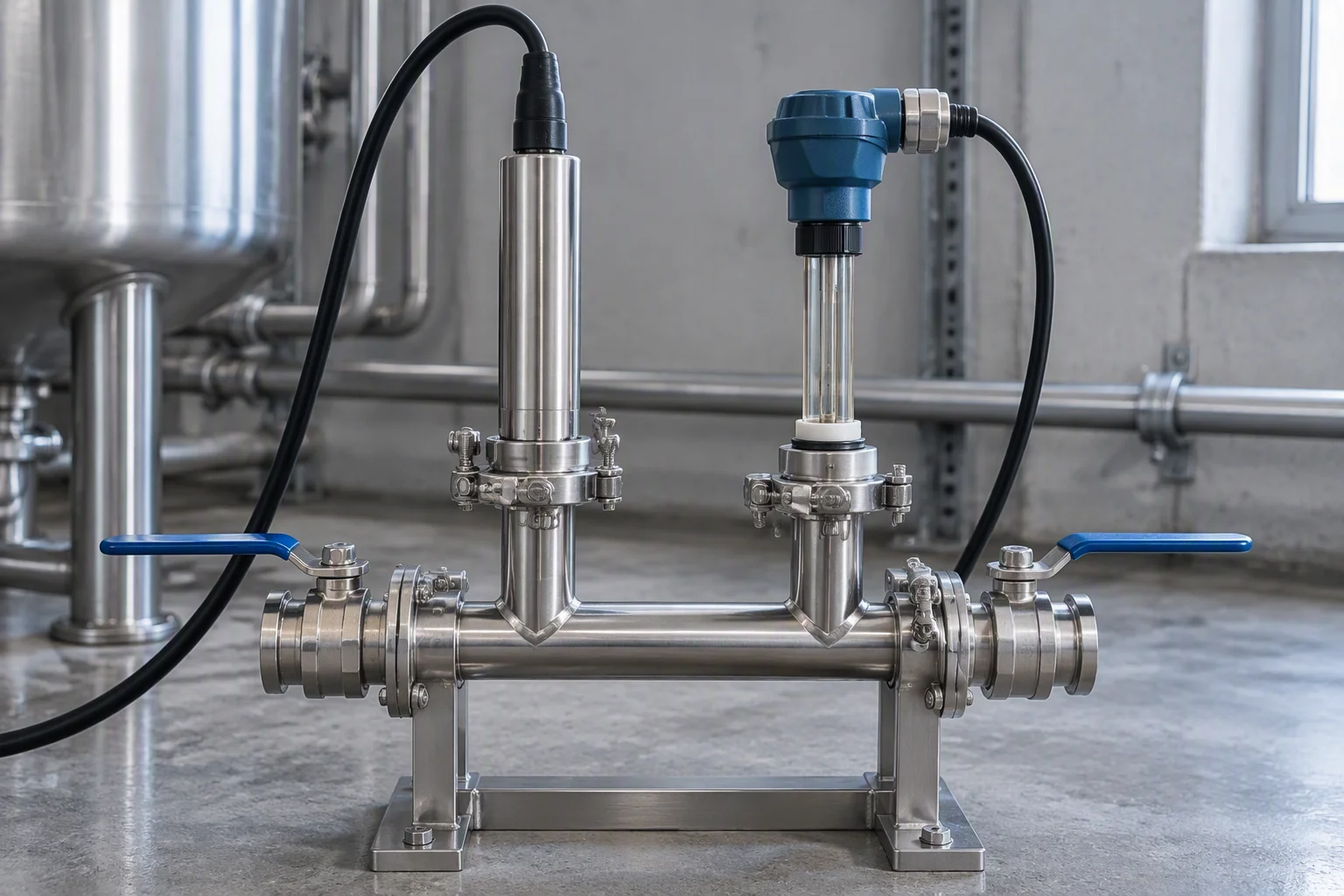
Bypass rack, conductivity cell and pH sensor.
Two conductivity bands, two loop chemistries
De-ionised technology loop 0.2–20 µS/cm, pH 8.0–9.5. Glycol-premix loop 50–300, pH 7.0–9.0.
Which cell reads your loop
A pure-water cell tops out at 20 µS/cm.
| Loop | Span | Verdict |
|---|---|---|
| de-ionised, 0.2–20 µS/cm | k = 0.01 cm-1 → 0.04–20 | |
| glycol-premix, 50–300 µS/cm | k = 0.1 cm-1 → 0.10–200 | tops out below 300 |
| glycol-premix, 50–300 µS/cm | 316 SS → 0.057–20,000 | |
| either loop | inductive, Noryl → 0–500,000 | |
| either loop, pH | process sensor → 0–14 pH |
Spans in µS/cm; k = 0.01 cm-1 for the de-ionised loop.
Contacting or inductive
Inductive cells are preferred on glycol loops. k to ISO 7888, ASTM D1125.
| Topology | Parameters |
|---|---|
| Contacting | k = 0.1 and 1.0 cm-1; 1.4435 |
| Temperature | minus 20 to 100 °C; 140 °C sterilizable |
| Pressure | 13 bar at 20 °C, IP68 |
| Inductive, PEEK | 0–2000 mS/cm, 170 °C |
| Inductive, Noryl | 0–500,000 µS, Modbus |
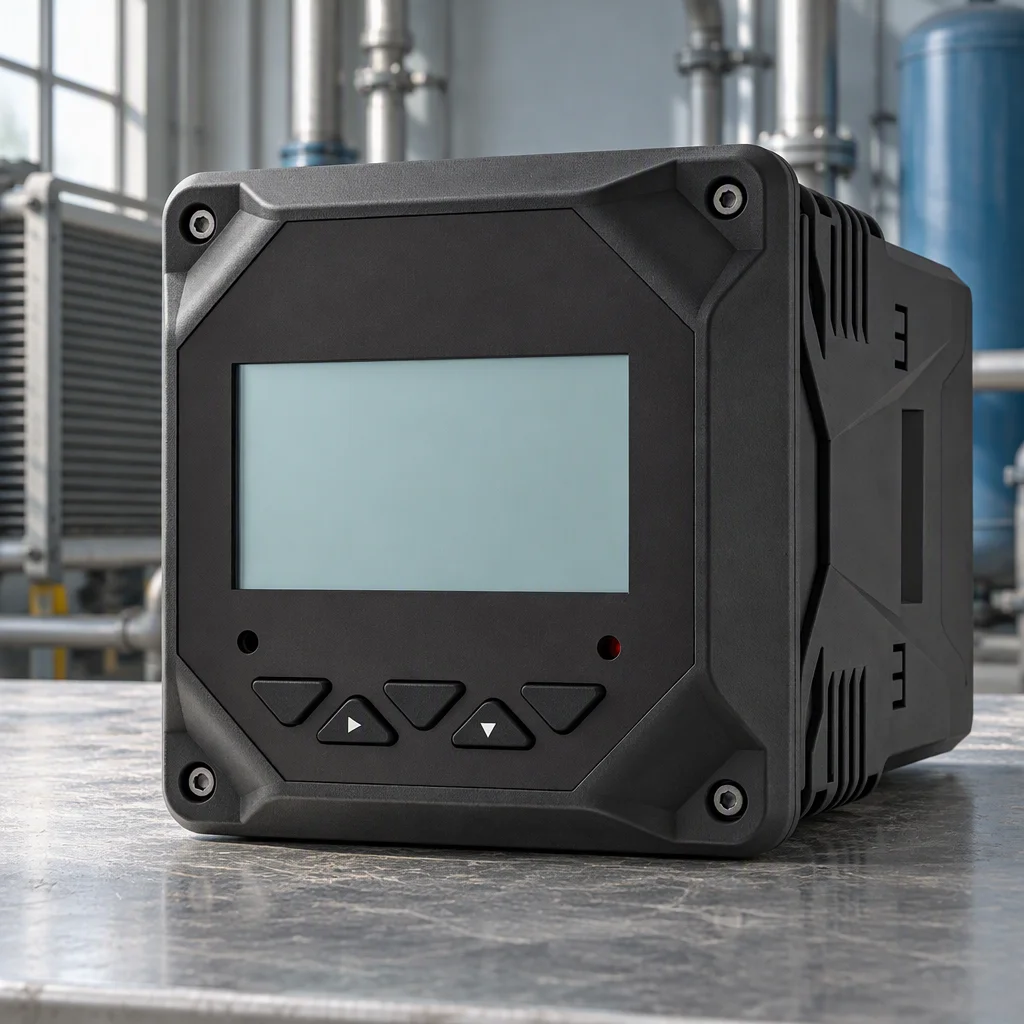
The pH envelope
| Parameter | Value |
|---|---|
| Range | 1–12 pH (A) · 0–14 (B) · 0–10 (F, HF at or below 1 g/L) |
| Temperature | A minus 15 to 80 °C · B 0–135 · F 0–70 |
| Pressure | A and B 0.8–17 bar · F 0.8–7 |
| Reference | PTFE junction, 3 M KCl, NTC 30 kΩ |
| Mechanical | shaft 120 and 425 mm; IP68 |
| Bands | 8.0–9.5 de-ionised; 7.0–9.0 glycol-premix |
| Fresh fill | ~8.8 at 33% v/v, DIN EN 1262 |
| Open row | accuracy, resolution, ISFET, calibration interval, sensor life |
One freeze-point curve
20% → −7.2 · 25% → −10.1 · 30% → −13.3 · 40% → −22.2 · 50% → −35.0 · 55% → −43.3 °C
A supplier datasheet publishes −11 °C at 25% v/v to ASTM D1177. Refractometer: 0.0–90.0% V/V, resolution 0.2%, accuracy 0.4%.
Cross-checks: refractive index 1.365 to DIN 51432-2; density 1.024 g/cm³ to DIN 51757. PG25: 2.88 mm²/s, 0.471 W/m·K, 3.92 kJ/kg·K.
Viscosity runs 1.7 to 8.2 mPa·s between 15% and 55% propylene glycol at 20 °C, so drift moves pressure drop, the pump curve and a meter's turndown.
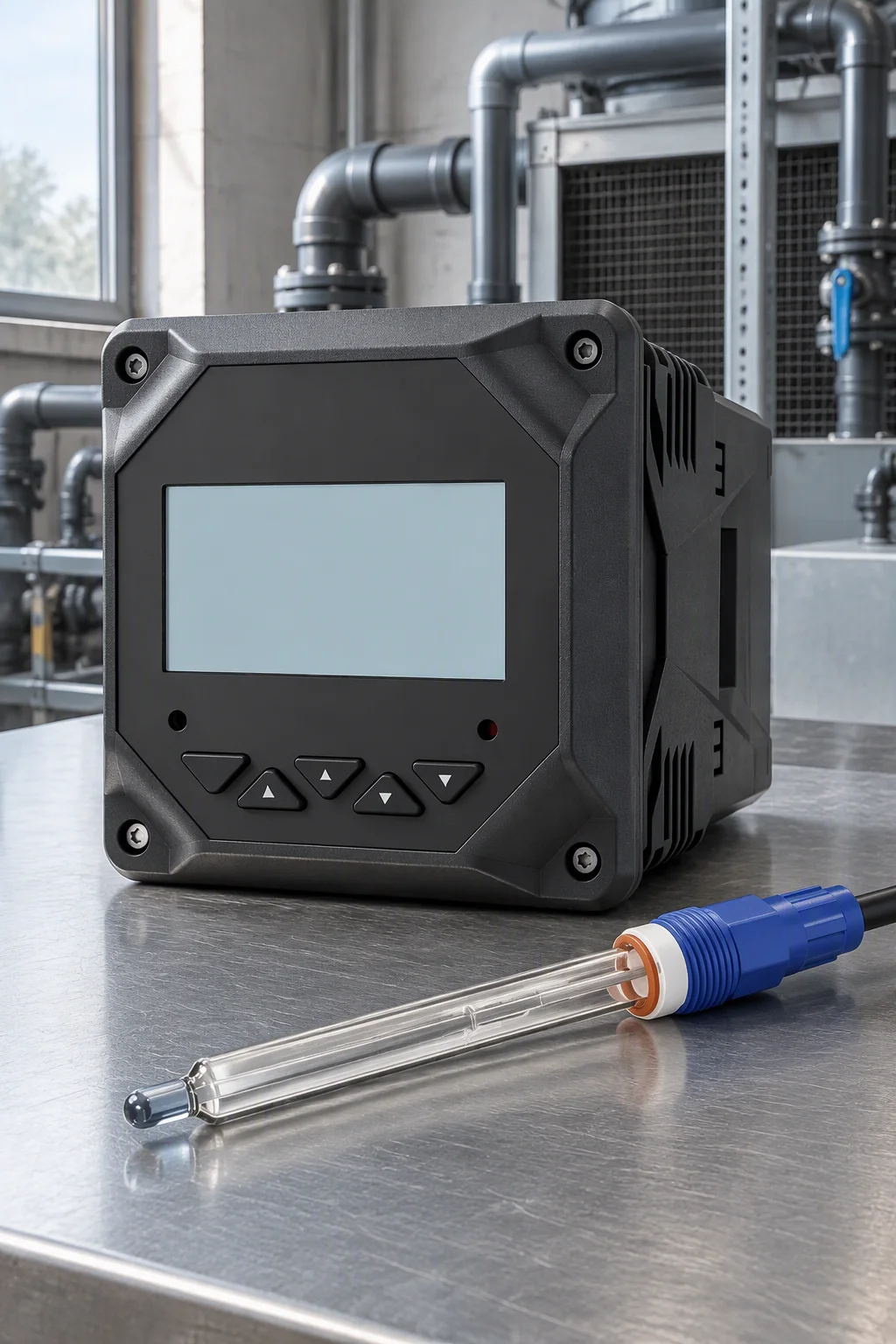
Turbidity and counting
Turbidity below 1 NTU, suspended solids below 3 ppm.
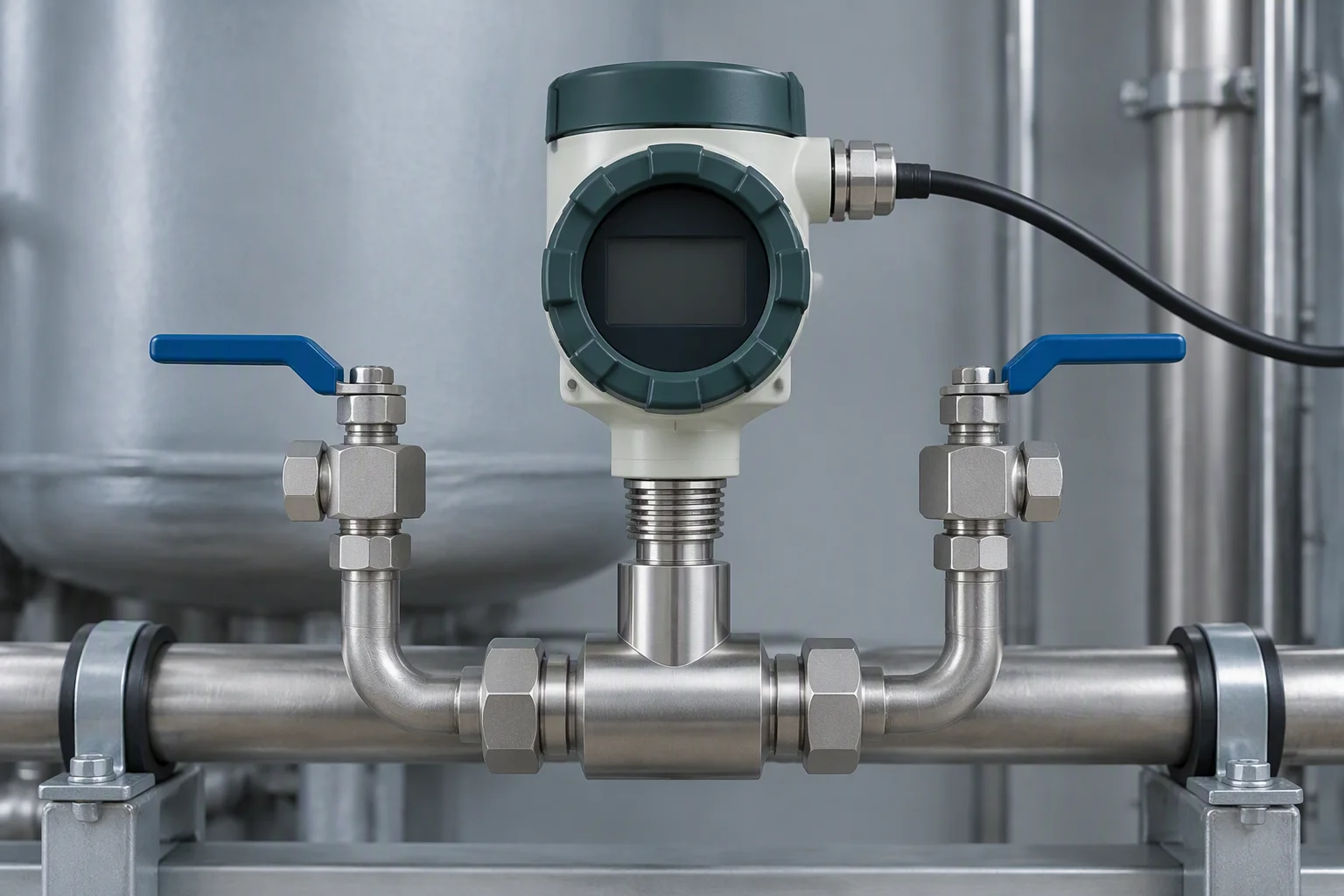
Counter
3-channel · ISO 4406 · 350 bar · IP65-67 · 4–20 mA
Monitor
ISO-calibrated · RS485, Modbus, CANbus · 420 bar
350 and 420 bar are hydraulic ratings; a side-stream vessel is 150 psi, 10.3 bar, so those are headroom.
Instruments trend; the lab decides
| Item | Value |
|---|---|
| Interval | 50–100 days, or quarterly, hot |
| Triggers | initial fill · make-up · the schedule · after a vacuum fill |
| Panel | appearance · odour · glycol concentration · freeze point · pH · reserve alkalinity · OAT inhibitor level · conductivity · ICP metals · anions |
| Reserve alkalinity | 1.4 mL 0.1 M HCl, ASTM D1121 |
| ICP metals | trace metals indicating corrosion |
| Anions | degradation by-products |
Most coolant systems sampled run out of specification; the source publishes no percentage.
Six codes, one sheet each
Download the EMS-CF-WQ-C specification sheet PDF| Code | Instrument |
|---|---|
| EMS-CF-WQ-C | contacting conductivity cell |
| EMS-CF-WQ-CI | inductive conductivity cell |
| EMS-CF-WQ-PH | process pH sensor |
| EMS-CF-WQ-NTU | turbidity instrument |
| EMS-CF-WQ-G | glycol refractometer |
| EMS-CF-WQ-PC | particle counter |
A code cannot be ordered against the wrong loop type.