Liquid cooling jumper hose, assembled to length
200 psi / 1.38 MPa working pressure, with a 1.5x proof record per bundle.
- A crimped bundle is ordered to length and cannot be repaired in the field.
- A clamped bundle is field-serviceable, and the clamp is the leak path.
- A quick-disconnect bundle trades two clamps for two seals.
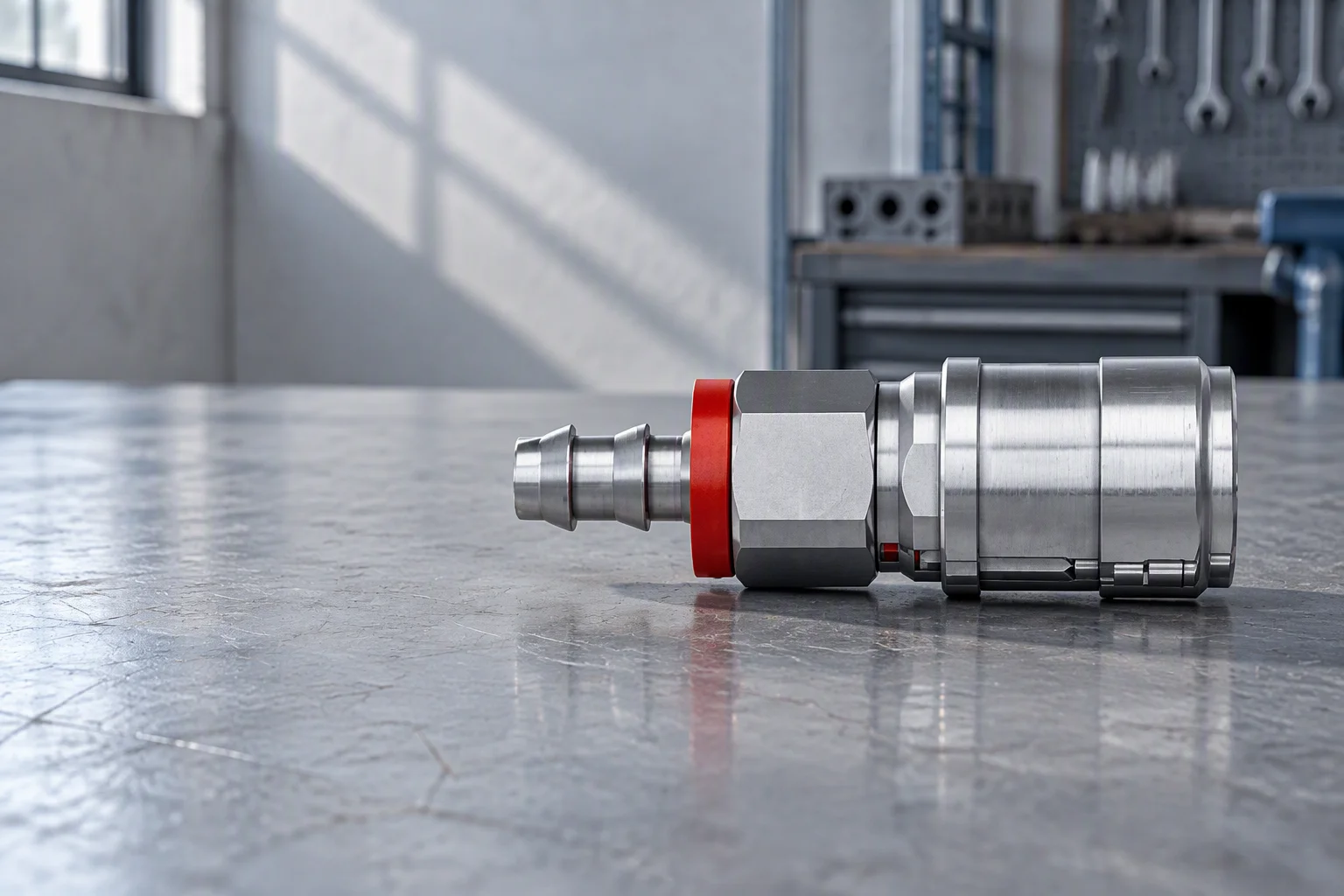
The rack jumper is not the row main
| Parameter | Rack-interior jumper | Row-level main |
|---|---|---|
| Dash | −4 to −6 | −16 to −32 |
| Braid | single-layer fibre | composite, two layers |
| Bend radius | 24.5 mm at −4, 37 mm at −6 | 127.0 mm at 1 in, 304.8 mm at 2 in |
| Working | 200 psi | 200 psi |
| Negative pressure | not specified | required |
| Changed when | node swap | rarely |
A row main bent to a 40 mm radius is out of specification.
The clamp is the leak path
A worm-drive clamp holds by stored stress. EPDM cold-flows under sustained compression, so the stress falls; at 200 psi the joint weeps rather than bursts. Countermeasures: a constant-tension clamp, a swaged ferrule, or a quick disconnect with no clamp.
Compression set under sustained clamp load is the mechanism, and 1.38 MPa is the pressure it leaks against.
A slow weep, not a rupture
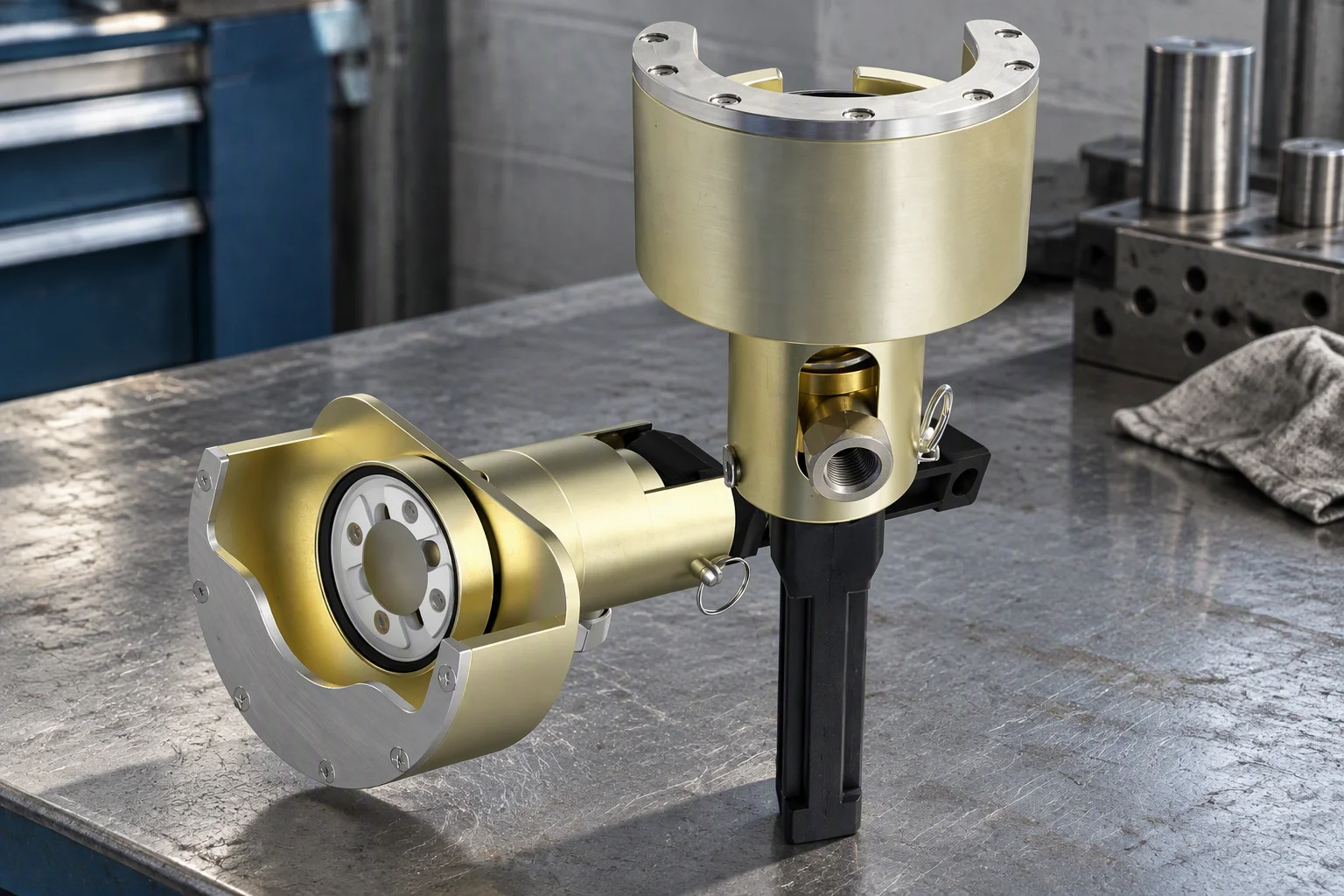
At 1.38 MPa with daily thermal swings the symptom is a slow weep at the clamp band.
The ratio belongs to the terminated assembly
| Rule | Value |
|---|---|
| Open Compute Project floor | burst at 3x maximum allowable working pressure |
| Measured, jumper hose | 1.38 MPa working, 5.5 MPa burst, 4.0x |
| Assembly promise | every EMS-HP-J code publishes its terminated-assembly ratio |
| Proof | 1.5x working pressure, air purged, deionised water or PG25 |
| Failure modes | hose rupture, thread stripping |
Legs, length and routing inside a rack
| Legs | Use |
|---|---|
| 1 leg | maintenance and bypass |
| 2 legs | supply and return to one node |
| 4 legs | two nodes on one bundle |
Bend radius follows the shortest leg: 24.5 mm at −4, 37 mm at −6. Cut-length tolerance is per bundle on the drawing. Red, black and blue zone the legs before fill.
Fluids a bundle is specified for
PG25, PG50, EG, deionised water, facility water, phosphate esters
EPDM is non-polar: good in water and glycol, poor in hydrocarbon oils
flush before the jumpers go on; cleanest the day it is bagged
Chlorinated or ozonated water is an oxidation exposure, which is why an ISO 1817 immersion result beats a compatibility chart.
What the bundle datasheet carries
Datasheet rows: model code, leg count, dash and bore, cut length with tolerance, termination each end, burst-to-working ratio for the terminated assembly, proof at 1.5x with hold time, seal material as EPDM 70 Shore A or FKM, colour, cleanliness state and packaging.
One inspection record per bundle: dimensional check, hydrostatic proof, leak-down hold, end-cap fit. Reorder by code and the specification does not drift.
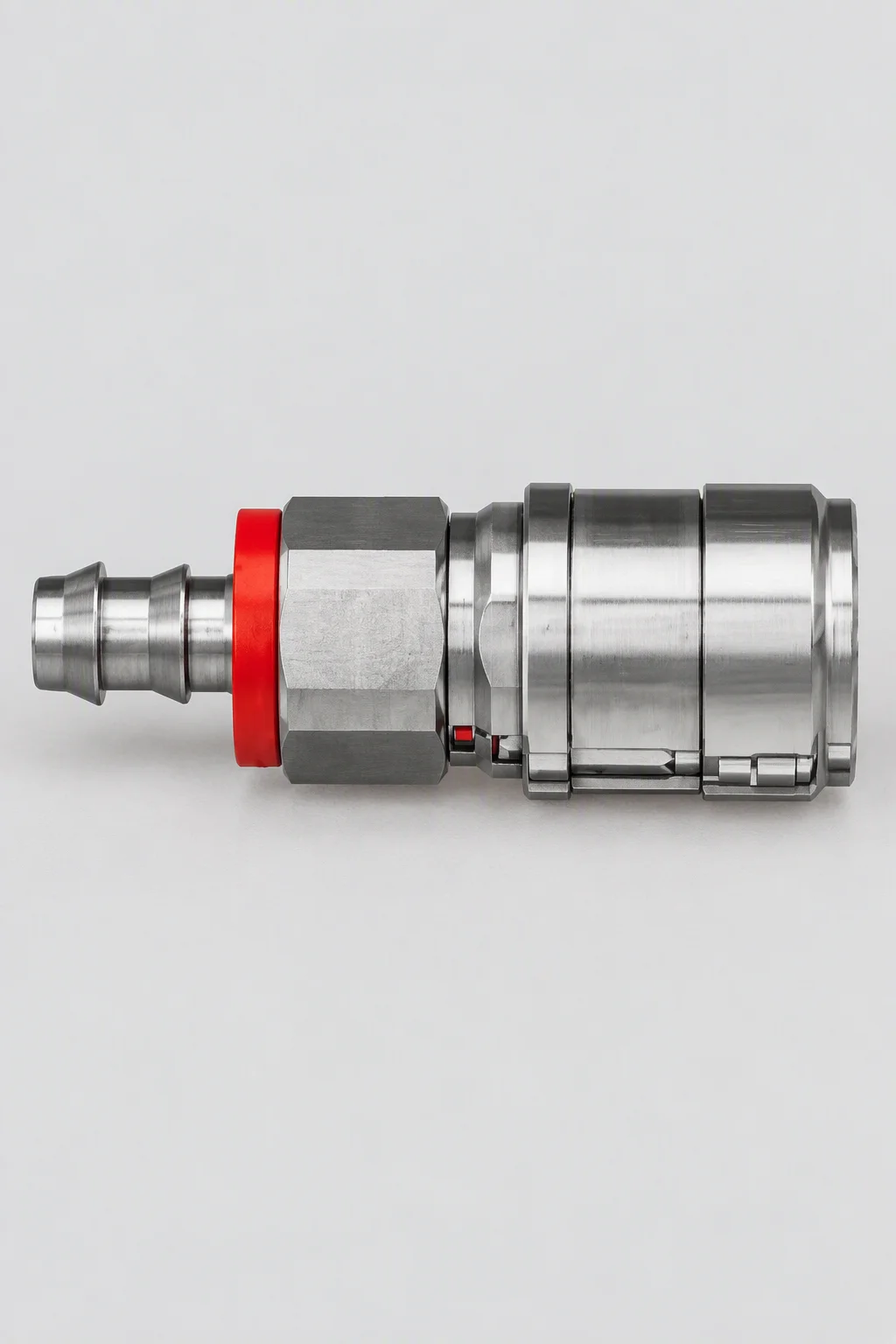
The eight bundle codes
| Code | Legs | Ends | Duty | Sheet |
|---|---|---|---|---|
| EMS-HP-J1-04-QD | 1 | QD | maintenance, bypass | |
| EMS-HP-J2-04-QD | 2 | QD | node supply and return | |
| EMS-HP-J2-06-QD | 2 | QD | standard node jumper | |
| EMS-HP-J2-06-CR | 2 | CR | permanent install | |
| EMS-HP-J2-06-CL | 2 | CL | field-serviceable | |
| EMS-HP-J4-06-QD | 4 | QD | two nodes, one bundle | |
| EMS-HP-J2-08-QD | 2 | QD | higher-flow node | |
| EMS-HP-J2-16-QD | 2 | QD | manifold drop |
QD: quick disconnect. CR: swaged ferrule. CL: constant-tension clamp.