Thermal grease, 1.0 to 6.0 W/m·K with impedance at 30 psi
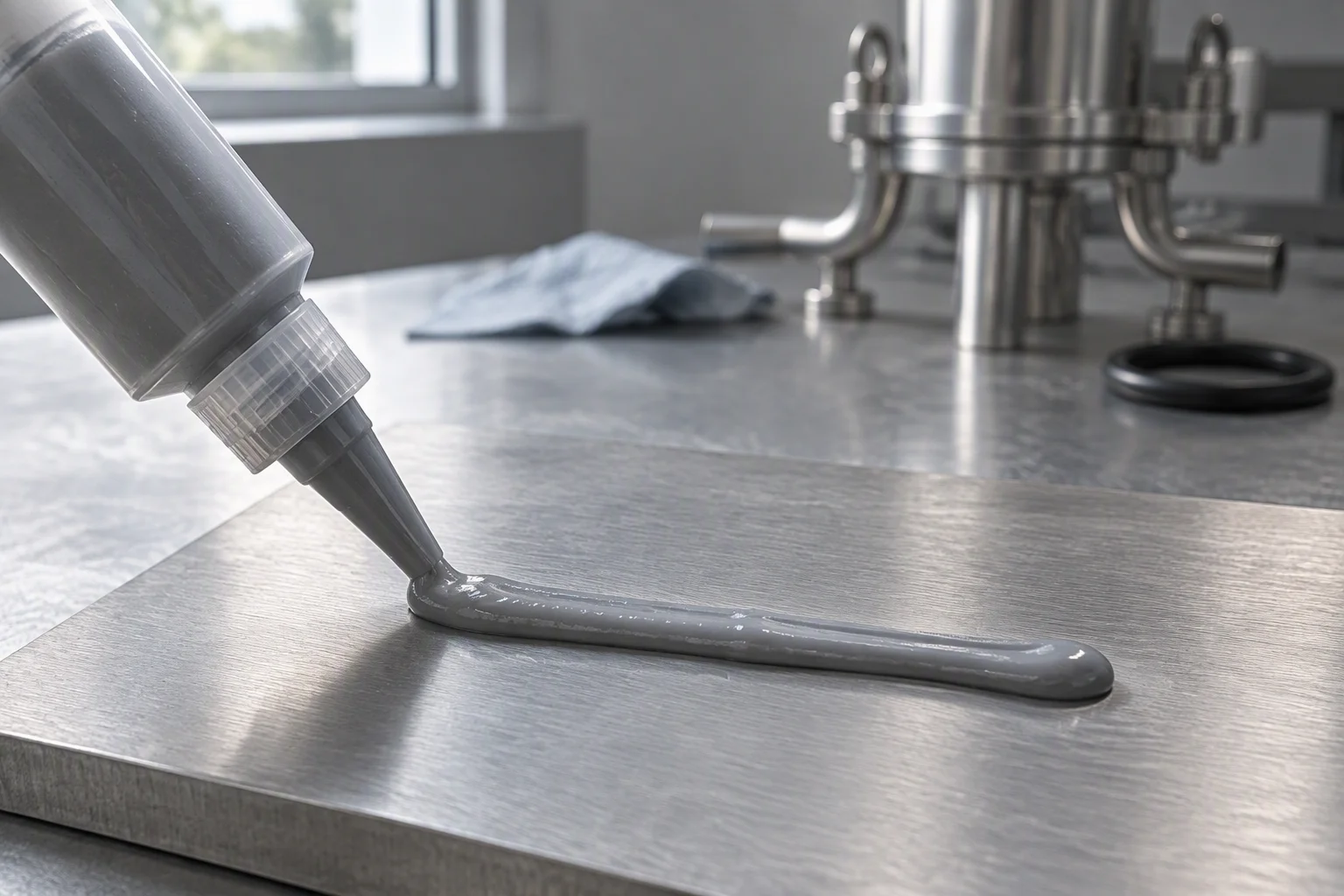
A non-curing paste that wets micro-gaps in a thin bond line and does not bridge gaps.
- Applied by stencil, screen print or syringe; supplied in 1 kg cans.
- Anchor grade, EMS-TM-G35: interface thickness 0.05 mm minimum, viscosity 280 Pa·s at 25 °C, density 2.6 g/cm³.
Pick the grade by impedance, not by W/m·K
| Model | W/m·K | Impedance, °C·in²/W | Sheet |
|---|---|---|---|
| EMS-TM-G10 | 1.0 | ≤ 0.060 | |
| EMS-TM-G20 | 2.0 | ≤ 0.050 | |
| EMS-TM-G30 | 3.0 | ≤ 0.030 | |
| EMS-TM-G35 | 3.5 | 0.020 | |
| EMS-TM-G50 | 5.0 | 0.015 | |
| EMS-TM-G60 | 6.0 | ≤ 0.015 |
0.020 and 0.015 are published figures. Bond line 0.05 mm minimum, −50 to +150 °C across the ladder.
The bond line is the specification
A phase change sheet arrives 0.20–1.0 mm thick, four times the 0.05 mm bond line a paste is designed for. Uncontrolled assembly pressure varies the bond line across the part, and impedance varies with it.
The buying questions published in this category are bond line, interface pressure, carrier and insulation requirement.
Pump-out under thermal cycling
CTE mismatch between die or lid and cold plate pumps paste out of the bond line over thousands of cycles. The countermeasure is a phase change material that softens at 45–55 °C, or a cured pad.
Grease stays correct on flat interfaces with hard stops that set the bond line.
Sealing reliability rather than heat rejection is the operating-time risk: a weeping joint and a pumped-out bond line share one mechanism, thermal expansion acting on 0.05 mm of paste.
Ceilings decide the class
Dry-out proxy on the anchor grade: thermal weight loss below 0.2 % after 125 °C for 48 h. A loop that runs hot removes the pad class before the conductivity comparison starts.
What the grease datasheet carries
| Row | Unit | Method or basis |
|---|---|---|
| 1 Model code | G10 … G60 | EMS-TM- prefix |
| 2 Thermal conductivity | W/m·K | ASTM D5470, three-point regression |
| 3 Thermal impedance | °C·in²/W | ASTM D5470, at 30 psi |
| 4 Test pressure and thickness | psi, mm | per row |
| 5 Minimum interface thickness | mm | 0.05 minimum |
| 6 Density | g/cm³ | ASTM D792 |
| 7 Viscosity at 25 °C | Pa·s | Brookfield RVF |
| 8 Operating temperature | °C | −50 to +150 |
| 9 Thermal weight loss | % | 0.2 at 125 °C / 48 h |
| 10 RoHS | pass / fail | IEC 62321 |
| 11 Halogen content | pass / fail | EN 14582 |
| 12 REACH | pass / fail | EN 14372 |
| 13 Shelf life | months | 12 |
| 14 Packaging and storage | kg/can, °C | per SDS |
A W/m·K figure without its test pressure and its thickness is not a specification.
Cases that route a buyer off this page
| Case | Where the answer sits |
|---|---|
| No dielectric figure is published for grease. The answer is a gap filler pad at ≥ 5.0 kV/mm by ASTM D149, or an insulator film. | |
| The 2025 REACH SVHC candidate list runs to 240+ substances and includes D4, D5 and D6. A silicone-free grease is quoted against drawing; the stocked grade is a pad at 2.0 W/m·K. |
Send the model code and the pressure
Model code · gap size in mm · assembly pressure in psi. You get the datasheet with its impedance at 30 psi, the safety data sheet and the lead time. Sample lead time is 5–10 working days.